With a new EP and a sold-out show under their belt, the Sydney band is ready to hit the road.
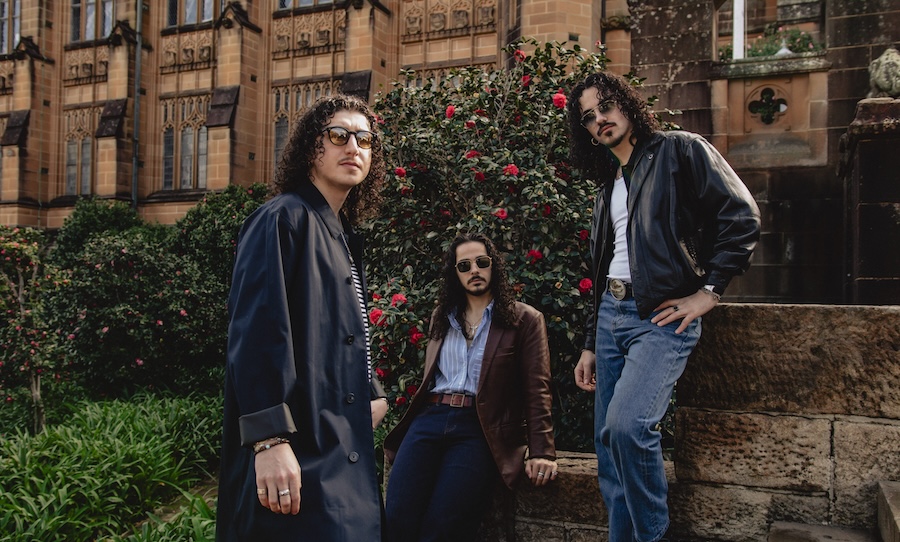
Sydney trio Necko are a band forged in the raw energy of the live arena.
With a sound that channels the spirit of 1970s rock, they have built a formidable reputation through relentless touring, supporting the likes of The Radiators and Mi-Sex, and captivating audiences with their explosive chemistry.
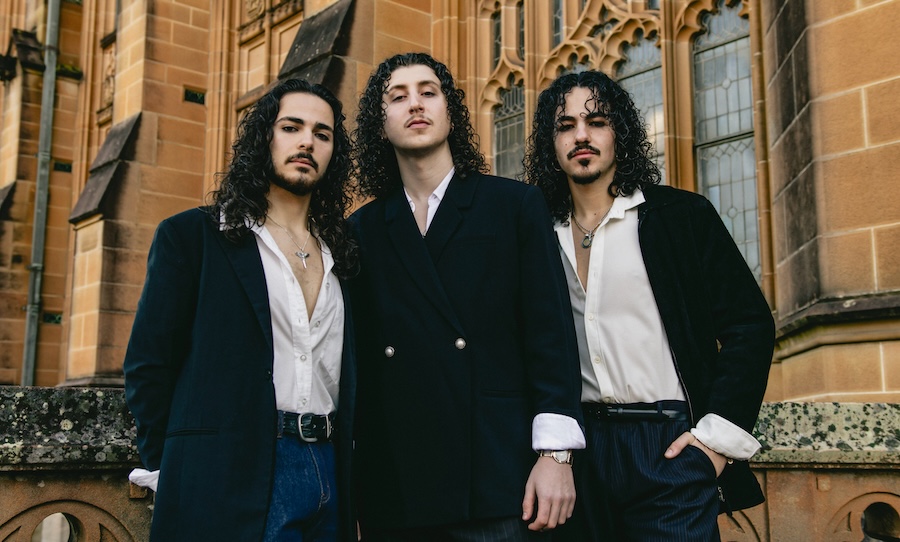
Following their EP, Necko II, which they debuted to a sold-out hometown crowd, the band is set to take their theatrical, blues-drenched rock on the road for the ‘Come As One’ Australian Tour.
The EP is a journey from delicate falsetto to roaring guitar, weaving medieval themes through tales of desire and heartbreak.
Now, with a string of tour dates locked in, the band is ready to translate their powerful studio sound into an even more immersive and unpredictable live experience.
We sat down with the boys to chat about all things coming up!
HAPPY: What are you up to today?
ALEK: Alex and I were actually on the hunt for flight cases as we’ve reached that stage now.
Preparing for the tour.
HAPPY: Necko II feels like a pretty confident statement of who Necko is. Did you go into this EP knowing exactly what you wanted the band to sound like, or did that identity emerge while you were making it?
RENO: Whenever we go into a writing or recording session, a completed vision is very rarely preconceived.
We always go into writing with an open mind, allowing the songs to evolve themselves, as the songs progress, our idea of the song becomes more apparent.
This also goes for Necko II.
The truth is we’re always evolving as a band and as creators, whatever we’re influenced by at the time will subconsciously filter into our writing process.
What we write now that we intend to put on the next record could drastically change by the time we’re ready to record, always allowing the space for the song to write it self, which I love.
HAPPY: There’s obviously a deep love of ’70s rock running through the record, but what are you listening to outside of that world at the moment?
ALEK: I’ve been listening to some emerging acts in our scene, of late.
RAGEFLOWER and Liquid Zoo are both cool: the former doing a sort of alternative pop with some incredible lyric writing and production.
The latter, Stonesy rock and roll.
I’ve also gone back to a record that I loved growing up, which is Guns N’ Roses Appetite For Destruction.
I hear it slightly different now than when I was a child.
I think now it’s more about the inspiration around creating a record that stands the test of time in that way.
HAPPY: Australia has a pretty serious history when it comes to big, unapologetic rock bands. Do you feel connected to that lineage, or are you mostly just focused on doing your own thing?
ALEX: In a way, yes we are connected.
It’s hard not to be as we’ve had so many groundbreaking bands come from Australia with the likes of AC/DC, INXS, Cold Chisel among others.
We feel a great national pride through them but at the same time a lot of our influences do come from abroad.
HAPPY: ‘You’ve Got What I Want’ has that immediate swagger to it. What came first with that track, the riff, the groove, the vocal, or something else?
ALEK: The main melodic guitar riff was the earliest piece I wrote for Necko.
I was in my home’s basement and put that down when the band itself was only a twinkle in my eye.
Here we have it now, a track that has, I suppose, defined our career thus far.
HAPPY: There’s a lot of imagery around sinners, glory, hymns, thrones and almost biblical-scale drama across Necko II. Where does that world come from for you?
ALEK: To me, music is as much about telling narratives as it is about relating it to your own life’s experiences.
You know, when you’re a child, and someone older tells you a story, you sit there, wide-eyed in a trance.
That’s what my favourite music does to me, and sometimes creating a new world out of true stories and telling them in a mystical way is the means to take the listener to another place.
I’m not overly interested in creating art that is instantly relatable—it needs to have enough substance to bring the beholder back time and time again to find more and more within it to connect to and discover.
As for those themes specifically, I suppose I’m just drawn to otherworldly, grand archetypes.
We can deliver larger-than-life pieces of music when the lyrical content is pushed to the same extremes as the instrumental.
HAPPY: ‘Hymn Of The Broken’ and ‘Bathed In Glory’ both lean into those big communal vocals and harmonies. How much time do you spend arranging vocals as a band?
RENO: It’s depending on the song.
Hymn Of The Broken and Bathed In Glory are two songs where all of the vocals were arranged in the studio within the 9 days we were there, aswell as Beggar On A Throne Of Gold.
I think it’s important vocal arrangements are approached in a meticulous matter, massaging and developing them overtime as it’s a crucial element and what defines the song.
However, Alek is a firm believer in leaving some of the vocal writing until the recording process.
He enjoys working under pressure, I feel there is a different kind of angst and emotion that is achieved, vocal arrangements and delivery are approached differently, something you can’t quite hear or achieve with a completed idea, where there’s not that same sense of urgency.
HAPPY: The guitars feel huge without completely swallowing the bass and drums. What was your approach to getting that balance in the studio?
ALEX: Tracking the songs in the room together really helped capture our live sound which gave each instrument its space to exist and breathe.
Al Sutton mixed the tracks and a big part of that sound comes from his expertise.
We had a specific sound in mind for the record and were adamant to achieve it.
HAPPY: Are there particular guitars, amps or pedals that have become essential to the Necko sound?
ALEK: There have.
I own several Heritage Guitars, two of which have defined our sound in different ways.
In terms of recording, my H-150 Standard Europe Factory Special Vintage Sunburst was played maybe eighty percent of the time for Necko II’s recording.
It’s on every track.
Interestingly, on stage, I play my other H-150 which is a Custom Core in black.
They seem to sit in different frequency ranges and respond differently which, I suppose, has influenced the difference in approach between the studio and live.
As for amps, my Marshall Astoria Custom was used for much of Necko II, and it’s my live amp.
I also used a Marshall 1974x for a lot of the solos.
Perhaps it’s an interesting correlation that both of those are combos.
My pedalboard has changed in small ways since the inception of the band, but there have been some mainstays including two Electro-Harmonix Holy Grail Reverbs that I combine for a wide spring effect.
I also stack two MXR Micro Amps to boost my amplifier.
View this post on Instagram
HAPPY: The record moves between really explosive moments and much more stripped-back passages, especially on ‘Beggar On A Throne Of Gold’ and ‘What Remains’. How do you approach dynamics when you’re recording versus playing live?
ALEX: I suppose in the studio it’s easier to achieve those lifts and falls through various recording and mixing techniques but live is a completely different story.
There’s no back up or assistance, it’s just us three.
We’re all constantly changing our sound throughout a song.
Whether it’s playing softer in parts or harder in others, or cycling through keyboard sounds and guitar pedals we’re never stagnant in our live performance.
HAPPY: ‘What Remains’ takes its time before everything finally breaks open. Was that six-minute structure there from the beginning, or did the song grow during recording?
RENO: What Remains was a demo that was written back in 2021 and was intended to be on the first EP.
The idea of the song was always characterised by its slowly burning introduction that gradually uncovers, crescendoing into a grand, anticipated climax, inspired by our arena rock heroes of the classic era.
However the song itself just didn’t seem to be ready to be introduced to the world yet.
We put it away for a couple years with the intent to pick it back up again, which we did.
The three of us embellished certain parts, put our personal flair onto it and Alek rewrote some of the lyrics, turning it into the track we knew it had the potential of being.
The modus operandi was introducing the calm and ending at the storm: that was the defining concept.
HAPPY: How much of Necko II was tracked live together? Was capturing the chemistry of the three of you more important than getting everything technically perfect?
ALEK: Absolutely.
We’ve been a live band for majority of the band’s history; only recording together over the nine days when Necko II was tracked.
It was super important to capture that energy.
We’re not perfect on stage, but that’s what I love about it: it’s always on the edge of destruction.
That, to me, is where much of the adrenaline of live performance lies.
We live on that tilt.
Five out of the six tracks were mainly recorded live in the room in one take.
We just overdubbed our favourite recording.
What Remains was the outlier: we felt as if it needed that separation to create as much angst as possible and to also build the track to its ultimate climax through adding instruments in every section.
HAPPY: There’s a lot of character in the production, cowbell, piano, acoustics, backing vocals, without it feeling overly polished. How did you decide when a song needed another layer and when to leave it alone?
ALEX: We really tried to have a less-is-more approach with this EP and letting the live aspect of us shine through.
There were definitely moments when we got a bit too eager to add more layers than necessary but our producer, Adrian, was quick to remind us of our initial minimalist concept.
The overdubs we did include were more so there to be felt as opposed to being prominent in the mix.
HAPPY: Do you have a favourite piece of gear, instrument or studio trick that ended up shaping this EP more than you expected?
ALEX: The fact that we did not use a click really surprised us in how different it made the songs sound.
It meant we really had to be in tune with each other and almost anticipate what was going to happen.
That spontaneity definitely shaped the sound.
What I think gives it unique character is that you can hear all our main live instruments influencing the overall sound of each track.
It’s a Necko record because it’s us playing our main instrument, just like we do on stage.
In future we may explore different pieces of gear, but we wanted this first recording of all three of us to capture our true live sound.
HAPPY: You’re taking these songs out on the Come As One tour soon. What changes once they move from the studio into a loud room full of people?
RENO: One of the many exciting factors of our show that the record will very rarely be translated the same way live.
Extended guitar solos, instrumental jam sections throughout songs and subtle nuances that differ from night to night really contribute to a unique experience every time.
It’s something we’re very conscious of and also very inspired by.
It’s rewarding as a performer to take a second to analyse the audience and witness the reaction of surprise and unexpectedness from a song they have only heard on record.
HAPPY: Where do you want Necko to go from here, bigger records, bigger rooms, more experimentation, or are you trying not to think too far ahead?
RENO: I think it’s healthy to assess all the possible tributaries that are ahead of us.
All of those factors are definitely what we hope for throughout our progression as a band.
Our upcoming tour is a great step in the next direction; building a bigger and stronger community outside our hometown is something we can’t wait to achieve.
Spreading our music and performance across the country and soon outside of Australia is all part of the dream.
Of course, we’d hope that creating the biggest records we can will directly correlate to playing bigger rooms, providing us the opportunity to perform our music to larger masses.
HAPPY: Lastly, what makes you happy?
ALEX: Sharing our songs live really fuels our fire.
Every time we step on stage, reality fades away and we enter a trance.
We aim for audiences to experience this with us.