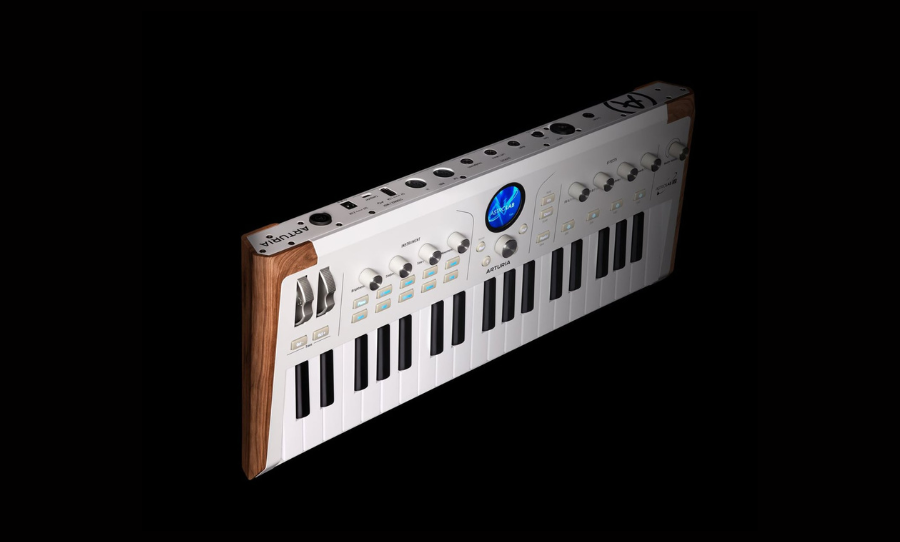
A portable stage keyboard with over 1800 sounds spanning synths, sampled instruments and hybrid textures, built for fast access and real time performance control.
There is a growing class of keyboards that are not really about sound design in the traditional sense anymore.
They are about access. The Arturia AstroLab 37 fits into that shift pretty cleanly.
On the surface it is fairly simple. A 37 key stage keyboard with aftertouch, a screen, and a small set of controls that are clearly aimed at performance rather than deep programming.
Nothing about it screams complexity when you first sit at it. That only really shows up once you start moving through the sounds.
The key idea here is the library. You are not dealing with a single engine or a narrow sonic identity.
Instead you are looking at more than 44 instruments and over 1800 presets pulled from across Arturia’s software range, including Analog Lab, V Collection and Pigments content.
That alone gives it a wide spread, but what matters more is how mixed that content actually is.
You have classic analogue style synths, modern digital sounds, and a lot of sampled and hybrid instruments as well.
Pianos, electric pianos, orchestral textures and more cinematic material all sit alongside the synth content, which makes it feel closer to a full production palette than a single instrument.
In use, it is not really about building sounds. It is about getting to the right one quickly and then shaping it in a musical way.
Everything is organised for browsing and recall rather than programming. You pick a sound, load it, and move on.
Once you are playing, the focus shifts to a small set of macro controls. Four main knobs give you real time control over key parts of the sound like tone, movement and overall character.
The important thing is that you are not thinking in parameters.
You are just pushing the sound in different directions while you play.
A static piano can slowly turn into something more atmospheric.
A pad can become more animated and unstable without ever leaving the performance view.
Effects are treated the same way. Delay and reverb are always within reach, along with a few assignable options depending on the sound.
It keeps things fast. You are not building chains, you are shaping space and movement on the fly.
Where it becomes genuinely useful is in how it handles organisation. You can build setlists and move through them in order, which makes it practical for live playing rather than just browsing presets.
Add in chord mode, scale mode and an arpeggiator and it starts to cover a lot of the groundwork for performance situations where you want ideas to happen quickly without a full setup around you.
The connection to Arturia’s wider software ecosystem is what ties it all together.
Sounds are managed through their companion software and can be prepared in advance, then pulled into the hardware for performance. It sits in that space between studio and stage quite comfortably.
The AstroLab 37 is not trying to be a deep synth or a traditional workstation.
It is closer to a performance instrument built around a large, mixed library of sounds.
The value is in how fast you can get to something usable and how easily you can push it into something more expressive while you are actually playing.
Check it out here.