We spent a few days with the OPFXS Dig Deep MK3 and it is not like other sub pedals
The Italian builder’s third take on its sub-harmonic octaver tracks chords instead of choking on them, and it comes with five knobs, MIDI, three presets and a split output!
We had the OPFXS Dig Deep MK3 in for a few days and it did not behave like any sub pedal we have used. Octave-down boxes usually promise a bass guitar and hand back a burp the moment you play anything more complicated than a single note on the low E. This one kept up. The bass it generates sits underneath your playing and your upper strings stay clean, so it holds together in a two-piece or in a band that has lost its bass player again. We still need to find the right song to show it off, because a one-note chugging riff gets nowhere near what the pedal can actually do.
Latency sits at roughly 5 to 7 ms according to OPFXS, which is close enough to instant that you play into it instead of around it. Anyone who has tried to write through a laggy octaver knows how much of the battle that is am I right?
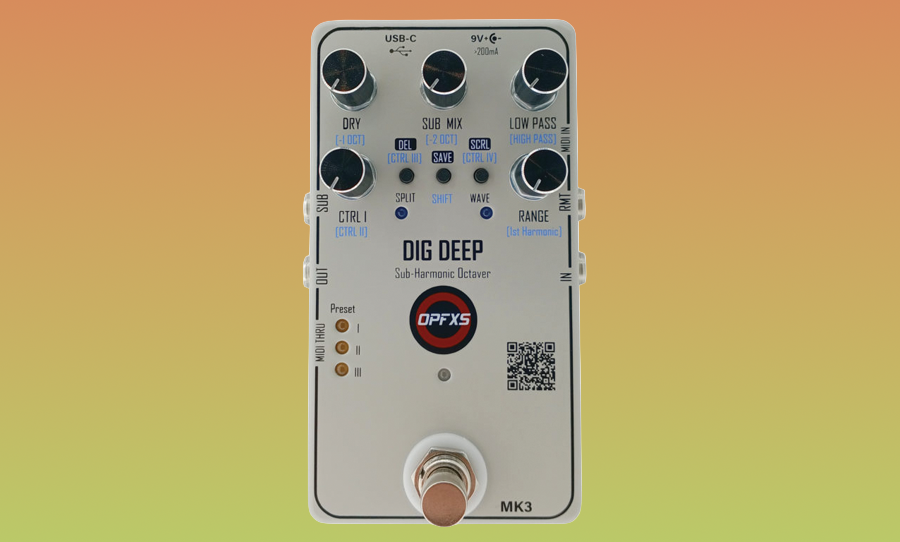
The MK3 runs five knobs and two control buttons, with a SHIFT button that opens a second layer of parameters on top of them. Dry sets your original signal and Sub Mix sets the level of the generated bass, with separate controls for the one octave and two octave down signals so you can blend how much of each you want.
Low Pass and High Pass shape the sub, and the high pass cleans up the noise you get feeding an acoustic into it. Range adjusts how far up the fretboard the pedal keeps tracking, and 1st Harmonic sets the level of the dominant frequency in the sub mix. There are also two assignable knobs and two assignable buttons, CTRL I through IV, which you map yourself in the editor app.
The Wave button steps through different sub waveforms for different bass sounds. Split sends the dry signal to the main output and the sub to its own SUB output, so the bottom end can go to a bass amp or a separate DI instead of asking one speaker to cover both jobs.
OPFXS says the MK3 holds together on arpeggios, strummed chords and complex chords and inversions right across the neck, and that matched what we got out of it. Two tracking tools do the heavy lifting. Dominant Notes Cut and High Notes Cut clean up the difficult cases like awkward voicings and open strings, and both can be assigned to the control buttons or stored permanently once you find a setting that works. The pedal covers six string, seven string, baritone, semi-acoustic and acoustic guitars across a range of tunings, although OPFXS does warn that very low tunings with heavy gauge strings can trip the tracking, so drop A players should test before they buy.
You can store and recall three settings, loaded by footswitch, remote switch or MIDI, and the pedal has MIDI In and Thru for bigger rigs. USB-C powers it and connects it to the editor application, where you assign controls, manage presets and push algorithm and firmware updates to the pedal. Power is either USB-C or a standard 9V DC negative centre supply, with protection against over-voltage, polarity inversion and over-current.
OPFXS also gives away a Dig Deep Sim plugin, so you can run the effect in your DAW and work out whether it suits your playing and your guitars before the hardware turns up. Octave pedals are personal and returns are a pain, so use it. The Dig Deep MK3 is listed at $394 AUD on the OPFXS site, shipping worldwide from La Spezia in Italy.
Check out the OPFXS Dig Deep MK3 here.