Imagine showing up to work every day knowing your job is to decide how close humanity is to wiping itself out.
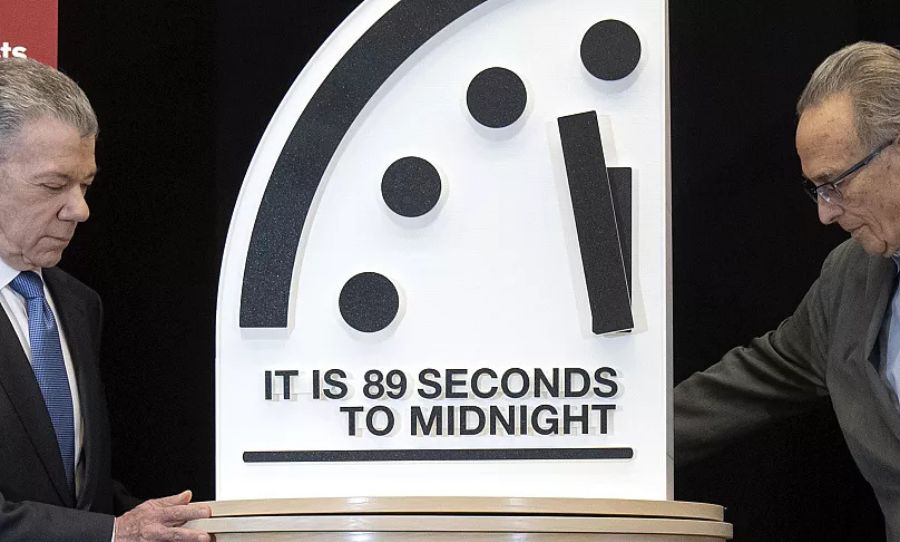
That’s life at the Bulletin of the Atomic Scientists (BAS), the group responsible for the Doomsday Clock, which as of January 27, 2026, now sits at a bleak 85 seconds to midnight.
It’s the closest the clock has ever been since its creation in 1947 – 4 seconds closer than last year – and, according to the BAS, closer than anything we’ve experienced before.
Before you freak out – the clock – which gets reset every January, isn’t a prediction of the future, it’s more of a symbolic warning to world leaders.
And this year, the message is loud, clear, and kinda grim.
So what pushed it forward from last year’s already terrifying 89 seconds? According to the Bulletin, it’s the collapse of global cooperation paired with a dangerous “winner-takes-all” mindset in international politics.
In other words: everyone’s acting in their own interests, and no one’s talking enough to stop things spiralling.
Nuclear risk remains the biggest immediate concern. With the New START Treaty – the last major arms control agreement between the US and Russia – approaching expiration, experts are warning about the very real possibility of a renewed nuclear arms race for the first time in 50 years.
There are fewer safeguards, fewer agreements, and far less trust holding things together.
That threat is amplified by ongoing and escalating conflicts involving nuclear-armed states. The war in Ukraine continues to destabilise global security, while tensions involving India, Pakistan and Iran add more pressure to an already volatile situation.
The Bulletin’s warning is simple: the margin for error is shrinking fast.
Climate change is another major factor behind the clock’s move. Despite years of climate summits and bold promises, progress toward Paris Agreement goals has stalled.
Meanwhile, extreme weather events – floods, heatwaves, fires – are becoming more frequent and more destructive.
The Bulletin also pointed to political shifts back toward fossil fuels as a sign that many governments are failing to treat the crisis with the urgency it demands.
Then there’s AI – a newer but rapidly growing threat. This year, the Bulletin explicitly called out the uncontrolled spread of generative AI, warning it could lead to an “information Armageddon”.
The concern isn’t just deepfakes or dodgy content, but the broader erosion of trust. When no one can tell what’s real anymore, solving big global problems becomes almost impossible.
To put things into perspective, the clock hasn’t always looked this dire. In 1991, after the Cold War ended, it sat at a relatively hopeful 17 minutes to midnight — the safest point in its history.
In 1953, during hydrogen bomb testing, it dropped to two minutes.
In 2023, it hit 90 seconds. Now, in 2026, it’s closer than ever.
Still, the Bulletin insists the clock isn’t destiny. “The clock does not predict the future; it illuminates our current reality,” said Bulletin CEO Alexandra Bell. “The clock has turned back before, and it can again.”
Which is comforting, sure, but you still wouldn’t want to be the person in that office moving the hands forward and telling the world, once again, that things are getting worse.