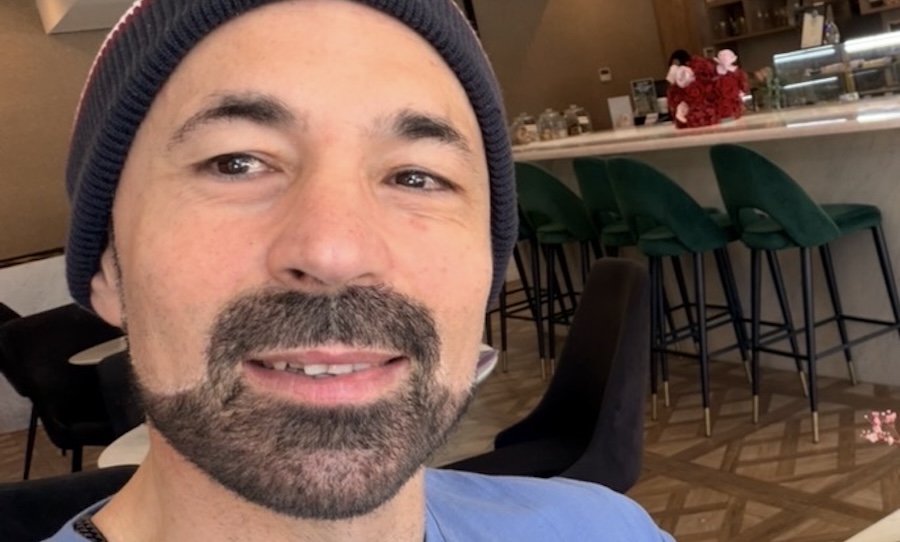
Inspired by the legendary Studio 54, George Galanis is crafting a world of his own.
We sat down with George Galanis, the man behind the moniker jeorjeo54, to discuss his Studio54 inspirations, collaborating with musicians around the world, and what impact being a perfectionist has on making music.
Hot off the back of his fresh collaboration with Jasmine Soto on ‘Burning Desire’, jeorjeo54 is experiencing some much-deserved time in the spotlight.

Written, arranged, produced and mixed by himself, ‘Burning Desire’ is a dance-pop track teaching us how to reclaim confidence after heartbreak one beat at a time.
Below, jeorjeo54 runs us through gear, inspirations, and life as a songwriter/producer always chasing perfection.
HAPPY: What are you up to today?
JEORJEO54: In between work, spending time with my family, working out at the gym and enjoying a strong skim latte, which is fairly essential, I’m currently mixing my second track, Plaything.
I’m working with Jasmine Soto again on the vocals, going through different takes and experimenting with timing, vocal entries and phrasing to find what works best emotionally as well as musically.
I’m also mixing the saxophone into the existing backing track and making sure it has enough presence without overwhelming what is already quite a full arrangement.
That part of the process can be incredibly detailed. Sometimes moving a vocal entry by a fraction, choosing one word from a different take, or changing the balance of an instrument can alter the entire feeling of a section.
I actually love that stage, because it’s where all the individual pieces finally start becoming a song.
HAPPY: Tell us a little about where you live. What do you love about it?
JEORJEO54: I live in the suburbs of Sydney, surrounded by trees, people, cafés and plenty of open space.
What I love most is that combination of activity and calm. I can sit in a café with a coffee and hear conversations and all the little sounds of everyday life happening around me, and then not far away there are trees and open spaces where everything feels completely different.
I think I’m quite inspired by ordinary life – the sounds, conversations, interactions and little moments you notice when you’re simply sitting somewhere watching the world go by.
There are stories everywhere if you pay attention to them.
HAPPY: What does a typical creative day look like for you? Do you usually begin with lyrics, a melody or a production idea?
JEORJEO54: I usually begin with an idea or an emotion: what do I actually want this song to say?
From there I start thinking about its world.
Before I even ask whether it is a ballad, dark and moody or of it will make you dance, the question I ask myself is, what should somebody feel when they hear it, and from there I dig deep and write the lyrics, immersing myself into the world of the main character who is singing the song, often just writing words at first to identify the emotion and motivation, and then going back to tame those words into lyrics.
Emotion is always at the centre of it for me.
There is absolutely a place for great throwaway pop that exists purely to make you feel good for three minutes, but that isn’t really what I’m drawn to writing.
I want there to be something underneath the melody – heartbreak, reflection, vulnerability, confidence, human connection – something that hopefully stays with you after the final note has faded.
Once I know what I want to say and lyrics are drafted, I begin thinking about how that feeling should sound, and the melody tends to grow out of that. I want the melody to complement the lyrics rather than simply sit underneath them.
Hearing ABBA’s SOS for the first time had an enormous impact on me.
I became fascinated by that contrast between a soaring, instantly memorable melody and the melancholy underneath it, and by the way the verses naturally build towards this unforgettable chorus. That tension still influences me enormously.
I suppose that is the space I’m always chasing: memorable hooks, cinematic atmosphere, dance-driven energy and genuine human emotion.
My songs are very lyric-focused, and I love powerful, expressive vocals where you believe the person singing the words rather than simply admiring the performance.
HAPPY: Tell us a little bit about your recording space—any pieces of gear you cannot live without?
JEORJEO54: I cannot live without my digital keyboard, digital drums and Logic Pro. They’re where a lot of the initial exploration happens and where the ultimate arranging, mixing, mastering happens.
I’m very much an instinctive, play-by-ear creator. Ultimately the important thing is that moment when something makes me stop and think, there’s something in that.
HAPPY: When you are building a song, what tells you that an idea is worth following?
JEORJEO54: It has to have something to say. I’m a very cinematic writer.
I tend to see songs almost as scenes – I imagine a room, a conversation, a particular expression on somebody’s face, a memory, even the lighting or atmosphere surrounding the characters.
I’m interested in capturing not simply what happened, but what that moment felt like.
I know an idea is worth following when it starts affecting me emotionally before the song even exists. If I can already feel the world of the song forming around that original idea, I want to find out where it leads.
HAPPY: jeorjeo54 takes its name from Studio 54. What is it about that era and its energy that still speaks to you?
JEORJEO54: For me, Studio 54 represents more than disco.
It represents this extraordinary collision of music, nightlife, fashion, theatre, personalities and artistic freedom.
There was a sense of possibility about it – the idea that you walked through those doors and entered another world.
That is probably the part that speaks to me most: transformation through music.
You can have whatever has happened during your day, whatever heartbreak or frustration or emotion you’re carrying, and then a song comes on and for those few minutes you are somewhere else. I love that combination of escapism and emotion.
The music can make you dance and feel liberated while still carrying sadness, longing or vulnerability underneath. That duality is very much what I’m interested in with jeorjeo54.
I want the music to have energy and movement, but I also want there to be a human story beneath it.
HAPPY: ‘Burning Desire’ started out under the working title ‘The Visitor’. How did the song change from that first idea into the finished track?
JEORJEO54: Originally, I imagined The Visitor as something much sadder.
In my head I could see a dark room, sombre lighting and two people confronting the remains of a relationship. The atmosphere was almost in the world of ABBA’s Like an Angel Passing Through My Room – quiet, melancholy and reflective.
But something interesting happened as I wrote it: the character in the song refused to stay heartbroken. The story became less about somebody mourning a lost relationship and more about confidence.
There is still vulnerability there, because I think confidence without vulnerability can become emotionally one-dimensional, but gradually sass, humour and defiance began creeping into the song.
The production followed that transformation.
Instead of sinking further into melancholy, it became increasingly rhythmic and confident. Adding the live saxophone was quite a late decision, but it changed the personality of the record enormously.
It brought this retro energy and almost became another voice in the song, answering and reinforcing some of the sharper lyrical moments.
That evolution ultimately became the identity of Burning Desire: melancholy is still underneath it, but now there is sass on top of it. The heartbreak hasn’t disappeared; the person experiencing it has simply changed.
HAPPY: You worked with musicians across Australia, Los Angeles, Ukraine and Mexico. How did you make an international collaboration feel so connected?
JEORJEO54: I think the key was having a very clear emotional picture of the song before asking anybody else to become part of it.
I wanted everyone involved to understand what their part was doing emotionally within the song, not simply what notes needed to be played or sung.
So there was a lot of communication, listening, exchanging takes and sometimes being incredibly specific about tiny details. With vocals, for example, a single word can completely change the meaning of a line depending on where the emphasis falls.
The same applies to an instrumental performance: technically perfect isn’t necessarily emotionally right.
What I loved was that everybody brought something of themselves to it.
I could provide the direction and the emotional framework, but then a musician or vocalist thousands of kilometres away would interpret that and send something back that added another dimension I hadn’t necessarily imagined.
By the time everything reaches me for arrangement and mixing, I’m not really thinking, “this came from Australia, this came from Los Angeles, this came from Ukraine or Mexico.”
I’m listening to whether all those performances sound like they belong in the same emotional world. When they do, geography becomes irrelevant.
View this post on Instagram
HAPPY: You have described yourself as a perfectionist. How do you know when a song is finished and it is time to let it go?
JEORJEO54: That is probably one of the hardest lessons for a perfectionist! I think the warning sign is when I realise I’m tweaking things simply because I can, rather than because the change is actually advancing the song.
There comes a point where another effect, another tiny EQ adjustment or another edit isn’t making the song better, it is simply making it different.
Eventually I try to stop listening as the producer and listen as somebody discovering the song for the first time. I’ll put on my ANC headphones, forget about the individual tracks and plug-ins, and just listen.
Even after months of working on something and literally hundreds of listens, I try to ask myself a very simple question: Do I enjoy this? Do I feel something?
Because ultimately a listener isn’t going to hear the microscopic adjustment I’m debating at two o’clock in the morning! They’re going to hear the song.
And I’m very conscious of not polishing something so relentlessly that I remove the personality that made me love it in the first place.
Perfection isn’t necessarily the goal. If the emotion is there, the song feels complete and I can listen without mentally reaching for the controls, that’s usually when I know it is time to let it go.
HAPPY: ‘Burning Desire’ is a confident first introduction to jeorjeo54. What does it tell us about where you want to take the project next?
JEORJEO54: I think Burning Desire establishes the DNA of what I want jeorjeo54 to be, rather than prescribing one particular sound I have to repeat.
I want to keep writing songs that are catchy and accessible but grounded in genuine human emotion.
There are so many feelings that are universal – heartbreak, desire, rejection, confidence, regret, vulnerability, that moment when you finally find your voice – and I’m fascinated by finding fresh ways of expressing those experiences through lyrics and production.
The next track, Plaything, continues some of those ideas but has its own personality.
I don’t want each release to sound like the previous one. I want each song to have its own world while still feeling recognisably like jeorjeo54.
Ultimately, I want somebody to be able to put one of my songs on, get up, dance, sing along and enjoy the hook – but then perhaps on the third or fourth listen, a lyric catches them differently and they realise there is something else going on underneath.
If someone reaches the end and feels they haven’t simply heard a song but have experienced a story and felt their own emotions through the experience for a few minutes, then that is exactly where I want to take this project.
HAPPY: What makes you happy?
JEORJEO54: Being surrounded by the people I love. Some of my happiest moments are actually very simple ones – sitting at a café with my wife and family, enjoying a strong coffee, people-watching, lingering longer than we probably intended, reading and just taking in the world around us.
I love that feeling of being connected to the people I care about while life is happening all around me.
Seeing the people I love smile makes me happy, as does feeling that I’m bringing positive energy into the lives of the people around me and, hopefully, making some kind of positive impact.
I’m also happiest when I have goals and a sense of purpose.
There is something incredibly satisfying about deciding I’m going to achieve something, putting the work into it and eventually being able to say, I did that. That applies creatively, professionally and personally.
Working out at the gym and going for a jog are a big part of that too.
I enjoy pushing myself and that feeling afterwards of knowing I’ve done something entirely for me – not because I had to, but because I chose to challenge myself.
Ultimately, happiness for me is probably a combination of connection and forward movement: loving the people around me, appreciating the ordinary moments, staying positive, having something to work towards and knowing that I’m continuing to become the best version of myself – for me, but also for the people I love.