The Virginia musician takes us inside the stories behind his new, stripped-back album, from wartime ballads to minor league anthems.
In May of this year, I booked my first-ever session in a proper studio. The resulting six hours yielded the songs you see before you.
It’s a collection in simplicity. Only two or three tracks per song, no pitch correction.
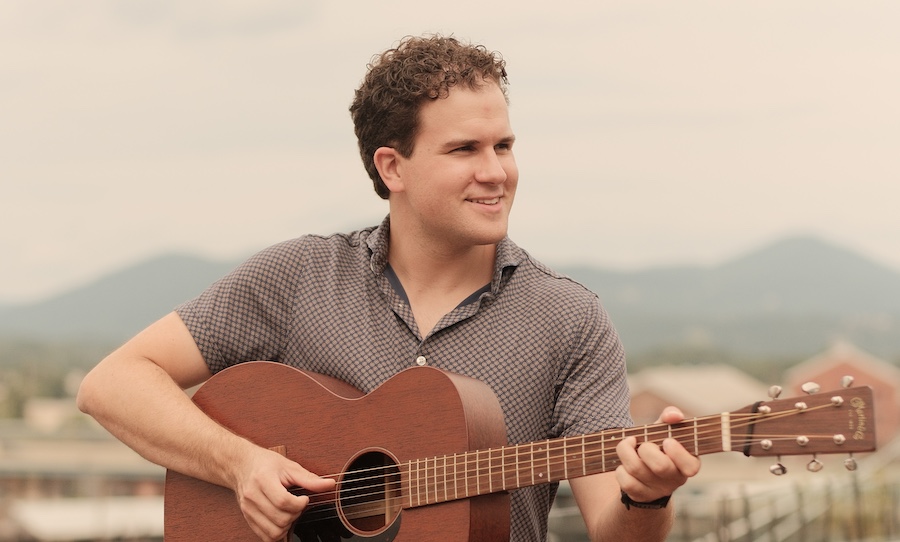
With this approach, I hope I’ve made the songwriting stand out. These are some of my best, telling of fleeting moments and entire lives, of lovers and abusers, of loneliness and connection.
Here, I’ll tell the stories behind each song on Rocket City. I hope you enjoy.
Mrs. Thomas,
“You didn’t mean for it to turn out like this.”
This was a bold choice to start the record, but one of the songs I am most proud to have written. “Mrs. Thomas,” is an abuse story. It opens on the reading of a letter by an observant and inquisitive teacher. It then finds the history: a high schooler falling for an older boy, an accidental pregnancy and shotgun wedding, a failed attempt to leave. This isn’t my story, but it’s a lot of people’s.
This was a unique song for me to write, in that I wrote all the lyrics first, then fit a melody a few months later. I was on a family beach trip, reading John Darnielle’s Devil House, and didn’t have a guitar with me or the space to work things out aloud. I think that separation in the writing was essential to making it sound as it does. I sing notes here that I probably wouldn’t have tried if I was stumbling to find melodies and lyrics simultaneously.
Rocket City
“Someday I’ll be an Angel / But for now, they fly too high.”
This is a relatively fun song for me. It’s about being a minor league ballplayer for the Rocket City Trash Pandas, the AA affiliate of the Los Angeles Angels. It’s a song I started in my head while on a walk around Burke Lake, thinking about a college pitcher I had watched who was then in the Angels organization. I got home and added a fun guitar part with lots of natural harmonics.
I got particularly into baseball in the middle of 2024, when my parents’ alma mater, the University of Tennessee, won the College World Series. I’ve since fallen for the sport in the way that only true nerds can. Good Lord, what a bounty of interesting statistics!
Whenever I tell a story that is not my own, I really hope I get it right. I don’t know what it’s like to play in the minor leagues. After the song was halfway done, I watched Bull Durham to get myself to finish the second verse. If I failed to capture this story authentically, blame Kevin Costner.
Across the Ocean
“I’ll spin the dial ‘til I win / A couple minutes with my love.”
In the fall of 2023, I went on a date with an amazing guy, and then moved to Slovenia later that week. Impeccable timing, I know. I wrote this song in retrospect, after moving back home. I had just heard “Bless the Telephone” by Labi Siffre and wished I had written it, and so I did.
Of course, we did break up (quite amicably) two weeks after I recorded this album. And yet, I’m still proud of the song and grateful for the relationship. The meaning has changed for me now. It’s more nostalgic. It calls me to a time that once was and cannot be again. It’s not uncomfortable or bitter. It’s just a sliver of time that once happened.
Advice Song
“Why are you coming to me for advice?”
When I was recording my first album, my other guitar player said he’d riot if I didn’t include this one. Well, Rex, you can put down your Molotov cocktail. It’s here.
This song started with the guitar riff. How could it not? It’s a deceptively easy line of hammer-ons that I wrote in my mom’s basement while home for college during the pandemic.
The lyrics started with a comedy-advice book I was reading at the time. I added a bridge a few years later, now rendered incorrect by age. This song’s been with me for a while- written at 21, modified at 23, and finally recorded and released at 25. With each moment, my potential as a serious provider of advice grows more credible, so I had to release it before its ironic nature fully withered on the vine.
Wilfred Owen
“But still they say / Just like before / That we should dance and die to drums.”
This, I suppose, is an anti-war song.
When Kurt Vonnegut was asked if Slaughter-House Five was an anti-war book, and he supposed that it was, Harrison Star told him, “Why don’t you write an anti-glacier book instead? It’ll do as much good.”
In the decades since, the anti-glacier movement has made incredible progress. If a group with no intentional practitioners can be so successful, maybe the anti-war crowd can be next.
This is the only cowrite I’ve ever released. I couldn’t have finished it alone.
My father joined the Air Force at 18 and retired last year at 55. He has never written a song, or poem, or fiction story, in his life.
I brought this to him when it was a straightforward biography of Wilfred Owen, the WWI author of “Dulce et Decorum Est”, which he had shared with me a few times in my youth.
He transformed it, bringing it from 1916 to 2004, replacing hardtack and mustard gas with Burger Kings and IEDs.
There are still lines I miss from the more biographical draft (e.g., “A broken man / Still smells the gas / at an ancient twenty-six.”), but this song works best as a memorial of regret.
An Inventory of Losses
“All I accumulate / Is an inventory of losses / When they crucify the carpenters / Who is left to make the crosses?”
“An Inventory of Losses” is a monument to what is no longer here. It’s a collection of things that have disappeared: Tuanaki, the Tasmanian Tiger, and ultimately, a view of the night sky.
I think Tuanaki is the most interesting of these mini-stories. It was (allegedly) an island in the Cook range, in regular contact with other Polynesians, explorers, and missionaries. It was not a Utopia, or some place descended into sin, like other stories of this nature. It was just a place. Once of peace and trade, of precolonial civilization. And between the successful expedition of 1842 and the failed expedition of 1844, it disappeared.
An underwater earthquake, most likely. Two tectonic plates slid across each other, and a people, a culture, were lost forever.
I try to picture the moment. A great shaking, the crashing of coconuts and timber, the panic, the confusion, the wall of water that approaches and rises and takes and takes and takes and does not retreat, a mad scramble towards the rafts as they float hundreds of yards away and getting farther, and then the expanse of the Pacific Ocean, blue and cold and endless. What floats, floats. What sinks, sinks. What treads water gets tired.
All that remains are a few shallow rocks, gouging their presence into a boat’s keel a quarter-century later. And now even the rocks are gone.
Tuanaki is a climate change story before the climate started changing. If I have grandkids, they would write this song about the Solomon Islands, the Maldives, Kiribati, or Tuvalu. We know this next earthquake is coming. It will be a fight. And, to quote one of Tuanaki’s last residents, “We do not know how to fight. We only know how to dance.”
This song would not exist without Judith Schlansky’s book of the same name. While writing this piece, I discovered that I was not alone in finding this an inspiration, as the band Beirut released a concept album (A Study of Losses) earlier this year.
If You
“So don’t remember the good times / You’ve got to think about the hurt.”
I pulled this one fairly literally from life. In the summer of 2023, I had a whirlwind three-nonconsecutive-day ‘relationship’ with a remarkable woman. It ended* with the reveal that she was still in love with her abusive ex-boyfriend.
*by which I mean I invited her to move in with me.
This was somewhat stream-of-consciousness, particularly towards the beginning, written with her in the room adjacent to mine.
The last verse adds a sick intrigue. The narrator also lacks control, he lets his emotions get the better of him. It’s a mystery how he’ll treat her if he gets the chance. You hope he learns restraint, or she learns to leave.
It Couldn’t Have Been All Bad
“We had a good year and a half / Well, thinking back, that wasn’t true / But there were smiles, there were laughs / And that’s what’s left when I think of you.”
It’s a Thursday in April 2022, and I am standing by the staircase of the Rotunda at the University of Virginia. It’s been a busy week, playing two shows on Tuesday, taking a string theory final on Wednesday, and with six more shows approaching like a taxi over the coming weekend. It’s an overly posh event, trappings of luxury wasted on the 22-year-olds about to head into entry-level jobs and minimum-rent apartments, or back to the even greater luxuries their families allow.
My ex-girlfriend is here as well. We’ve done the polite dance of avoidance throughout the event. Now she approaches, intent on the exit. A wave of memories cascades. Our introduction, a current and former Alabamian being introduced at orientation. The months of communication, the discovery that she actually was attracted to men in general and me in particular. The dates, the jokes, the serious moments. The kindness, and the months of not feeling how I wished I did, and the worries about what she would do should I leave. The breakup, the pandemic, the nationwide reaction to an article she’d written.
I say hello.
She continues, not acknowledging.
It’s a five-second non-exchange that will stay with me. On Saturday, I will write this song in the fifteen minutes I have at home between three shows. On Sunday, I will play it at a solo show at the Southern. I will forget the second verse. So it goes.
Brownstone
“I dreamed us young again…”
This is a love song of retrospect. It’s looking back on a life that I have yet to live, flipping through a yet nonexistent photobook.
Having not yet lived this life, having not yet felt this well-seasoned love, I found myself stuck after the first verse. I needed a visit from my aunt and her kids to jump-start anything further. Microdosing the role of a parent helped.
This one began as I often start songs, with a guitar melody and scanning my eyes through a book of poetry. The opening line, and the idea of a brownstone house, come from “The Week Before She Died” by Elise Paschen, although the subject of that poem is the narrator’s mother, and not a love story.
Words by CD Barnes.