Another day, another war.
In a single, whiplash day, Donald Trump pivoted from promising Iran’s “annihilation” to embracing a 14-day ceasefire.
The dramatic reversal came as Pakistani intermediaries and even China worked furiously behind the scenes to de-escalate a nearly six-week-old war.
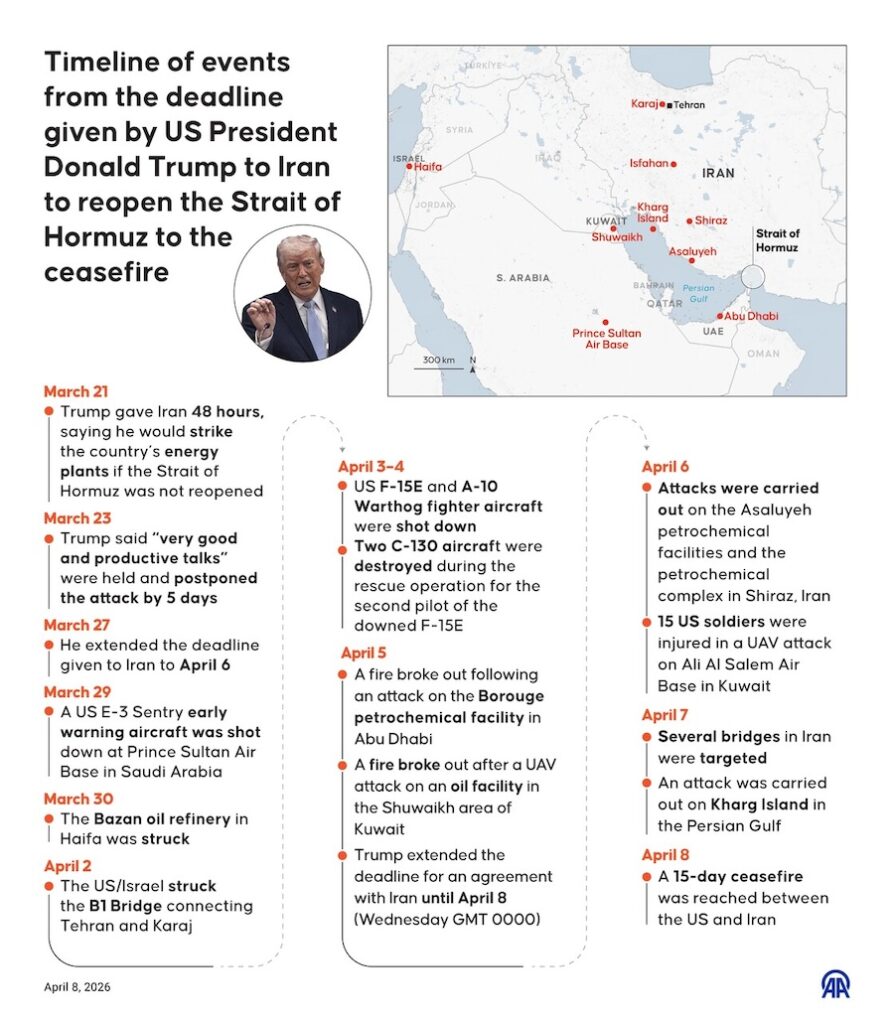
With a deadline looming to open the Strait of Hormuz, Trump instead took to social media to declare military objectives “met and exceeded” and announce a temporary truce.
But the bombast masked a quieter calculus. Defense analysts warned that seizing the strait would require up to 45,000 U.S. troops and an “indefinite” occupation potentially lasting two decades.
The ghost of Afghanistan’s forever war haunted the decision. Trump’s proposed solution, allowing both Iran and Oman to charge tolls on the waterway for the first time in history, drew immediate fire.
Senator Chris Murphy called it “a history-changing win for Iran” and proof of “stunning” incompetence.
Yet the president has a pattern of maximalist threats followed by last-minute retreats, from “Liberation Day” tariffs to demands for Greenland.
Pope Leo XIV had condemned strikes on civilian infrastructure as “truly unacceptable,” and Democratic lawmakers decried the annihilation threat as a moral failure.
The White House instead framed the ceasefire as a triumph of military leverage and tough negotiation.
Whether it holds, or simply resets the clock for another two-week drama, remains an open question.