Electricity, gesture, and the art of not touching keys
There are synthesisers you program and then there are synthesisers you perform. And then there are instruments like the SOMA Flux, which feel less like a machine and more like volatile (in a good way) organism waiting to be approached.
View this post on Instagram
SOMA Laboratory have built a reputation for instruments that reject convention. Their designs rarely begin with a keyboard (we’d love to see some of their prototype sketch pads). So what happens when you remove the usual control surfaces and let electricity respond directly to the human body? Flux is one answer to that question.
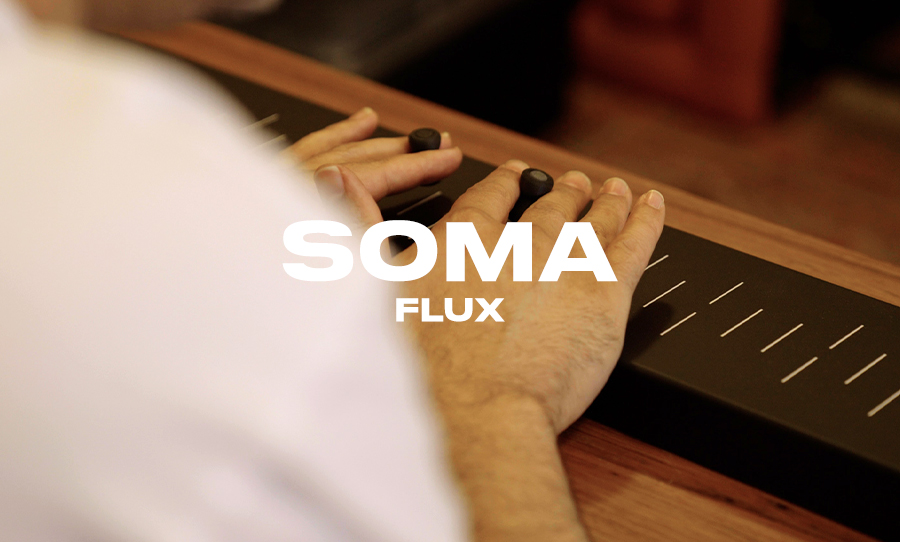
At a glance it resembles a theremin, but that comparison only goes so far. Where a theremin gives you two antennas and a fairly narrow interaction model, Flux expands the concept into a richer magnetic and touch-sensitive field. The core interface is based on two magnetic ‘bows’ held between the fingers and a multipolar magnetic sensor that tracks their position (and orientation) which at times felt like playing something ancient or something from the future!
The experience is fluid and strangely intimate. Vibrato becomes a physical tremor of the wrist. Pitch bends feel continuous and vocal. Microtonal slides are not programmed but embodied. There is something deeply expressive about an instrument that refuses to snap to semitones unless you force it to.
Under the hood, Flux’s synthesis is DSP-based (with high-quality digital-to-analog conversion). Oscillators and modulation paths live in the analogue domain, giving the instrument a rawness that pairs beautifully with its gestural control. The sound can be warm and singing one moment, unstable and fractured the next. Feedback paths and internal interactions mean that pushing the instrument harder often leads to unexpected harmonic behaviour.
That unpredictability is not a flaw. It’s the core of the instrument.
It thrives in ambient spaces, cinematic scoring, experimental performance, and anywhere texture and expression matter more than strict note accuracy. It excels at long drones that shimmer and wobble with organic instability. It can deliver eerie leads that feel half electronic, half human. It can also tip into noise and distortion if you challenge it.
What makes Flux particularly compelling is the way it changes your posture as a musician. You are not hunched over a grid or tapping plastic keys. You are standing, hovering, shaping invisible fields of sound. It becomes almost choreographic.
There are a few things that immediately stand out when spending time with Flux:
-
It forces you to listen more closely because pitch is continuous rather than locked
-
It rewards subtle hand movements instead of dramatic gestures
-
It exposes imperfections in intonation in a way that feels human rather than wrong
-
It encourages slow, evolving performances over rapid note entry
-
It makes you aware of electricity as something physical, not abstract
In a world where so many tools are optimised for speed and convenience, Flux feels deliberately slower and more demanding. It asks for presence. It asks for intention. It will not politely sit in the background while you scroll.
That can be confronting. It can also be liberating.
There is something refreshing about an instrument that does not try to be everything. Flux will not replace your polysynth. It will not become your DAW in a box. It exists alongside those tools as a reminder that electronic music can still feel tactile and alive.
SOMA have never been interested in following trends, and Flux continues that lineage. It’s strange in a thoughtful way. Expressive in a physical way. Unstable and yet, very musical. Get your flux fix here.