
Casting a shadow on the sun.
From the grit of Newcastle emerges Mangy Mutt, an artist who trades polished comfort for raw, sonic documentation of a scrambled life.
His debut EP, The Unresolvable Disillusionment of Matthew David Bowman, is a stark exploration of cycles, scars, and unresolved truths.
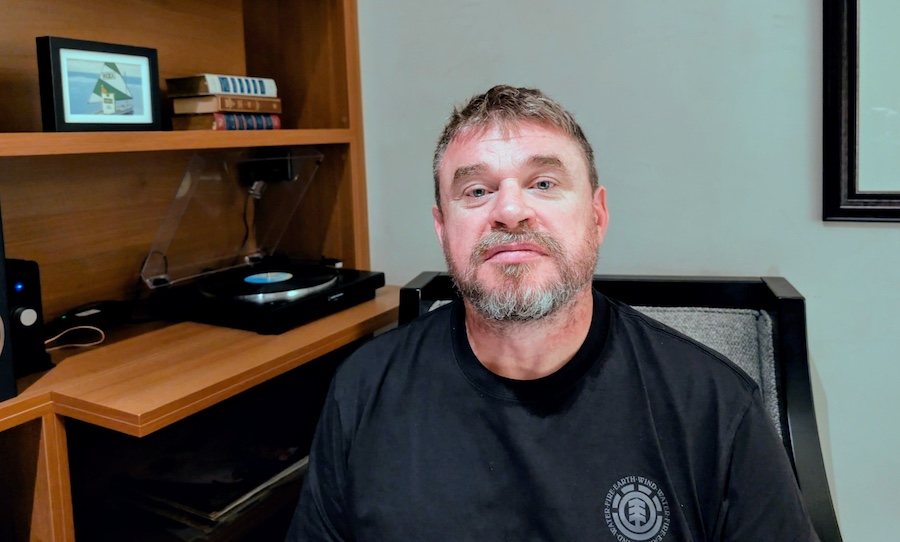
Recorded with Gareth Hudson at Hazy Cosmic Jive Studio, the project balances cinematic depth with a mangy edge, offering no neat endings.
In this candid interview, the artist behind the curtain, Matthew David Bowman, discusses embracing chaos, the loops of mental health, and finding strength not in answers, but in the struggle itself.
He reveals a journey through breakdown, diagnosis, single parenthood, and sobriety, where writing became the only anchor, and where love, ultimately, is the answer.
HAPPY: What’d you get up to today?
MANGY MUTT: I had a really bad sleep last night so I just stayed home and watched a bit of TV. Wrote a song and did a bit of laundry. My life is rather exciting at the moment.
HAPPY: Tell us a little about where you’re from, and what you love about it!
MANGY MUTT: I grew up in Dundas Valley in Sydney but now reside in Lake Macquarie. I’ve lived here for 23 years and I think many would agree that I have yet to grow up.
HAPPY: The EP’s title is incredibly specific: The Unresolvable Disillusionment of Matthew David Bowman. Who is Matthew David Bowman in this context?
MANGY MUTT: Matthew David Bowman is the person behind the curtain — the one I’ve avoided putting on display until now.
This EP isn’t about revealing every detail; it’s about acknowledging the weight of experiences that don’t resolve cleanly.
The title points to that ongoing struggle, the sense that understanding yourself is a moving target. It’s me stepping forward without pretending I have it all figured out.
He is someone who has developed a lot of resilience over time. Someone who has fought in many different internal battles and keeps walking
HAPPY: What does “unresolvable” mean to you, and why is embracing that concept central to your work?
MANGY MUTT: For me, ‘unresolvable’ is the recognition that some parts of a life don’t settle into neat explanations.
There are experiences, questions, and versions of myself that don’t line up, no matter how much I try to make sense of them. Instead of forcing closure, I’ve learned to work inside that tension.
It’s central to my writing because that’s where honesty is — not in pretending things are fixed, but in acknowledging what refuses to be tied up.
HAPPY: You mention capturing “the cycles we get stuck in.” Which track on the EP feels most like being trapped in a loop, and how did you capture that sonically?
MANGY MUTT: The track that really embodies that feeling of being stuck in a loop is ‘Cast a Shadow on the Sun.’ The whole song lives inside a cycle you can’t break — the same room, the same thoughts, the same rituals that offer no relief.
Lines like brushing my teeth offering no relief or smashing my face in the mirror repeat that sense of going through motions that never change anything.
Sonically, I leaned into that repetition: the progression barely moves, the rhythm circles the same emotional ground, and the vocal phrasing keeps returning to the same patterns.
It’s meant to feel like you’re pacing the same four walls, even when you think you’re moving forward.
View this post on Instagram
HAPPY:The EP is described as a document of a “scrambled” life. Was there a challenge in structuring chaos into a coherent collection of songs?
MANGY MUTT: All of it hit at once — the breakdown, losing the ability to work, a new diagnosis, old trauma resurfacing, a separation, suddenly becoming a single parent to two teenage girls on the spectrum, all while trying to hold onto long‑term sobriety.
It was an overwhelming period of my life. Writing became the one thing that gave me hope, the thing that reminded me there was still something worth holding onto when everything else felt impossible.
After doing the work and treating my mental health, it became easier.
HAPPY: You admit you don’t have the man in these songs figured out. Does writing them feel more like an interrogation or a confession?
MANGY MUTT: It’s not that I don’t have the man in these songs figured out — it’s that I’ve learned to accept that it’s okay not to have him figured out. I’m comfortable with the chaos now.
I don’t approach the writing as an interrogation or a confession; I try not to overthink the words because that’s when it all gets complicated.
The less I interfere with the flow, the more honest the songs become.
Letting things stay unresolved is part of the process, and the songs are stronger for it.
HAPPY: If this EP is about “disillusionment,” what were you disillusioned with?
MANGY MUTT: I’m not actually disillusioned — I just thought it was a good title. The songs deal with different sides of mental health and addiction, and the title holds all of that without needing to explain anything.
I’m not the man in the songs; it’s just a hidden side of me, the side I’m most comfortable in and the side I draw strength from. I don’t try to figure him out. I try not to overthink the words, though I still do at first, and that’s when structure gets complicated.
Once I let the flow take over, the songs become more honest. The EP doesn’t offer solutions — it offers an experience of what that darkness feels like from the inside.
HAPPY: Now that this chapter is taped and released, where does the search for truth lead you next?
MANGY MUTT: There is no closure. This is life. I still struggle with different aspects of it, and if I don’t maintain a certain lifestyle, I could find myself back in the same place — maybe one day I will. I’ve found the truth, but it’s not something you arrive at and keep.
The further down the road I go, the more I realise I know nothing. Age feels like a myth; if anything, the further I’ve travelled, the more childlike I’ve become.
I live with my sixteen‑year‑old daughter and half the time I forget I’m the parent — I just want to scrap with her. The clarity comes from the struggle.
It’s alright not to be alright, and you don’t have to get it right all the time. Sometimes the best you can do is hold space and let people learn their own lessons, even if some of those lessons come through you.
Underneath all of it, love is the answer.
HAPPY: Lastly, what makes you happy?
MANGY MUTT: What makes me happy? Happiness comes and goes like everything else. Nothing in particular makes me happy.
I’m comfortable in the chaos. It’s the contradictions in life where the answers are held. Being content in all of it is the answer for me.