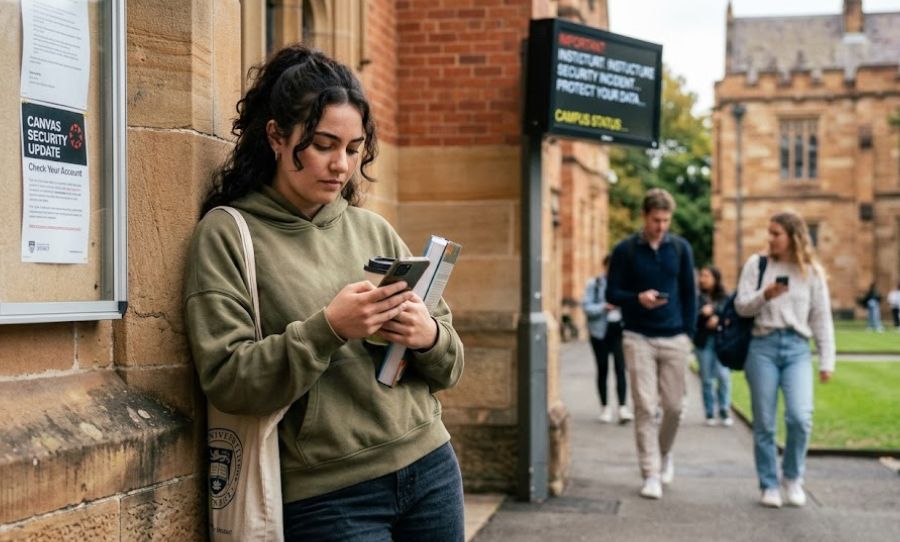
A massive Canvas breach has landed this week.
If you’ve used Canvas at uni or school, there’s a decent chance your details could be caught up in it. No need to panic – but it’s definitely one to understand.
Here’s the straight-up, useful breakdown of what’s going on – and what it means if you’re a student, lecturer, or just someone with a login.
What actually happened?
In early May 2026, the hacking group ShinyHunters claimed they’d pulled off a huge data grab from Instructure’s cloud systems.
– Around 3.65TB of data allegedly stolen
– Up to 275 million users impacted
– Roughly 8,800–9,000 institutions affected globally
Instructure confirmed a cybersecurity incident on May 1. Within a couple of days, it became clear student data had been accessed. Some universities reported Canvas being temporarily taken offline while security fixes rolled out.
Big picture: this isn’t a niche breach — it’s one of the largest education-platform incidents we’ve seen.
What data was exposed?
According to current statements, the breach includes:
– Full names
– Email addresses
– Student ID numbers
– Internal Canvas messages (yes — DMs between students and teachers)
What wasn’t taken (so far)
– Passwords
– Financial details
– Government IDs
– Dates of birth
That’s important — but it doesn’t mean you’re in the clear.
Why this still matters
Even without passwords, this kind of data is prime fuel for targeted phishing.
If someone has your:
– name
– uni
– and internal comms context
…it becomes much easier to send convincing fake emails that look legit.
Think: “Your assignment submission failed — log in here” or “Canvas security reset required.”
That’s where the real risk kicks in.
What you should do right now
Nothing dramatic – just a few smart moves:
– Don’t click random Canvas emails. If something asks you to log in or reset your password, go directly to your uni’s Canvas page. Don’t trust links.
– Turn on MFA (if you haven’t already). Multi-factor authentication is your best safety net.
– Keep an eye on your inbox. Watch for anything slightly off – weird wording, urgent tone, unfamiliar links.
– Check your uni’s updates. Institutions like University of Sydney and University of Technology Sydney have been issuing their own alerts with campus-specific advice.
So… how worried should you be?
Short answer: aware, not panicked.
There’s no evidence (yet) of passwords or financial info being leaked, which keeps this out of worst-case territory. But the scale is huge, and the data that was exposed is exactly what scammers love.
This is one of those moments where being slightly more cautious online for a few weeks goes a long way.
If your uni has sent you a Canvas-related alert, it’s worth actually reading it (for once). If not, now you know what to watch for.