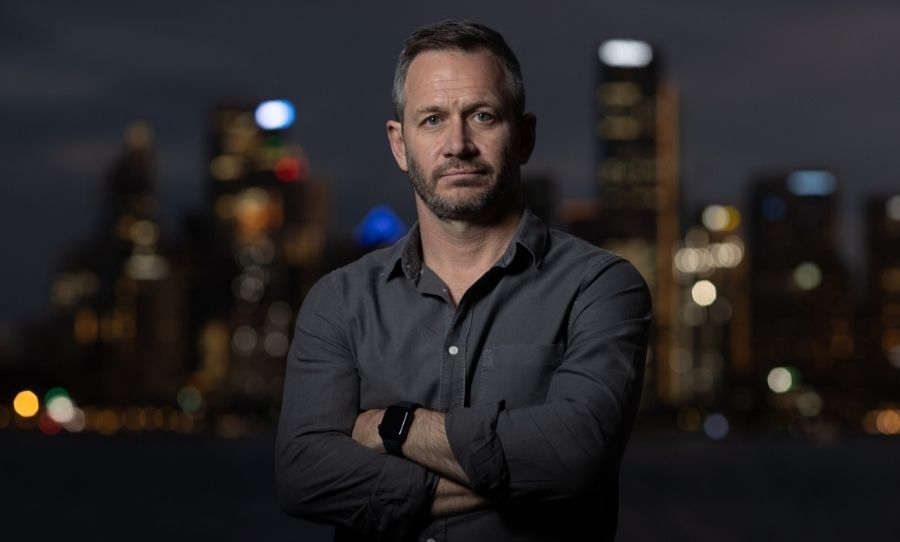
We talk Dark Desert Road, writing, extremism, and family in an exclusive chat with Tim Ayliffe
Tim Ayliffe has long been one of Australia’s sharpest voices in crime fiction, and his latest standalone, Dark Desert Road, proves he’s still at the top of his game.
The novel unspools across rural NSW, where survivalist cults, far-right extremism, and long-buried family secrets collide, all seen through the eyes of Kit McCarthy–damaged, determined, and unflinchingly human.
Ayliffe’s journalism background shines through in the way he builds tension without sacrificing realism.
His portrayal of Australia’s regional landscapes is both vivid and unsettling, reflecting the political and social fractures creeping into communities across the country.
Yet at the heart of the story are deeply personal stakes: the fraught bond between Kit and her twin sister, Billie, whose choices ripple across the novel in unexpected ways.
In an exclusive interview, Ayliffe shared insights into his process, from early-morning writing rituals to researching local communities in the Riverina, and how his years reporting globally inform his fiction.
Dark Desert Road is a thriller that chases adrenaline, all the while asking questions about loyalty, belief, and the forces that can push people toward extremism.
With this one, Ayliffe grabs readers by the collar and refuses to let go.
HAPPY: What have you been up to today?
TIM AYLIFFE: I was up at 515am working on a new novel.
I love writing at this time of day because it’s peaceful and quiet and my brain tends to work better in the early mornings.
I did a few chores, picked the kids up from school, walked the dogs and went for a swim late in the afternoon.
Not a bad day, really!
HAPPY: Tell us a little bit about where you live, and what do you love about it?
TIM AYLIFFE: I live in the inner west near the Cooks River where I enjoy walking the dogs.
We’re pretty close to the city too, which is great.
And it’s multicultural, with great restaurants and bars.
HAPPY: You’ve spent decades reporting across the globe. How did growing up and working in Australia shape the way you tell stories?
TIM AYLIFFE: I love being an Australian and writing about our country – the good and the bad sides of life.
Australia is much more connected to the rest of the world than it was when I was growing up – so the issues impacting people in Europe, America and parts of Asia are similar to the challenges we experience at home.

HAPPY: Dark Desert Road takes us into rural NSW and a world of survivalist cults and extremism. What drew you to this setting and these themes?
TIM AYLIFFE: There are deep cracks emerging in democracies all over the world, and Australia is not immune.
Irresponsible social media companies have allowed extremist groups to spread their hate and grow, connecting like minded people like never before.
Trust in government and institutions is also dwindling.
This type of alienation stokes anger and fear and it’s particularly acute in some regional areas where people feel forgotten.
I also love the diversity of our country and enjoyed researching the book in the Riverina, speaking to locals and ensuring I got the setting right.
HAPPY: Kit and her twin sister Billie have a tense, complicated relationship. How did you approach writing sibling dynamics that feel so real?
TIM AYLIFFE: All families are complicated in different ways.
I’ve seen how sometimes the most intense bonds can be broken by simple acts of betrayal, or neglect.
The stakes are always higher with siblings – and twins – because they share a unique connection, a shared truth.
Siblings see through each other’s lies.
HAPPY: The novel touches on far-right extremism, youth radicalisation, and disinformation. How much of what you write is inspired by real events versus pure fiction?
TIM AYLIFFE: While the plot is fiction, the book is rooted in fact.
I try to write novels that shine light into dark places and explore complicated issues, and show how, for instance, a smart young woman can be radicalised into believing and doing terrible things.
It always surprises me how often it happens – how intelligent people can be hoodwinked by an extremist cause.
Often it is the result of a single act – a betrayal of some sort – or deep loneliness, that sends them down this road.
HAPPY: You’ve had unique access to law enforcement and intelligence sources. How did that experience inform the story of Dark Desert Road?
TIM AYLIFFE: It helped me to ensure that the characters I created and the plot were believable.
And I was particularly interested in the connectivity between extremist groups in places like the US and how they connect to what might be going on in Australia.
HAPPY: What do you hope readers take away from seeing these towns through Kit’s eyes?
TIM AYLIFFE: Kit is a city cop from Sydney, so she experiences the hot, dry country of the Riverina as an outsider.
I loved writing some of the characters that she encounters – often straight talking, genuine people that call things for what they are.
People in these areas also have a strong connection to their community, and when they see someone being wronged, or in trouble, they want to help.
And that is a key part of Kit’s experience in the book.
HAPPY: Writing crime thrillers that feel grounded yet page-turning must be a delicate balance. How do you keep the tension high without losing realism?
TIM AYLIFFE: I think my career as a journalist has helped me here.
But I also write with a philosophy that everything in my books either has happened, will happen or could happen.
So if I don’t believe what I’m writing, then the reader won’t.
HAPPY: Looking back at your career and your novels, what do you think makes Dark Desert Road stand out from your previous work?
TIM AYLIFFE: It’s my first standalone novel outside of the John Bailey series.
Dark Desert Road is told from two perspectives – twin sisters. One of them is an extremist, the other is a cop.
So this book is unique for me as it’s as much about family as the thriller plot that drives the story.
HAPPY: And finally, what makes you happy?
TIM AYLIFFE: Hanging out with my wife, our two kids and our dogs.
I’m a simple person in that regard.
I also don’t mind a glass of wine and a surf, when I can.
And it would be good if the Wallabies would start winning a bit more often.