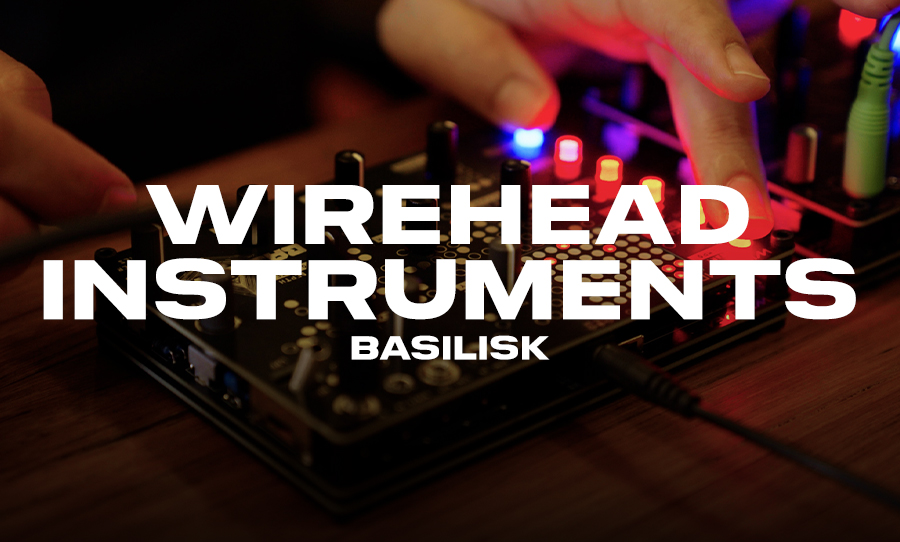
A generative groovebox built for curiosity, mutation, and musical accidents
There is a growing class of instruments that challenge a familiar assumption in electronic music. That the musician must directly choose every note. Instead, these instruments suggest something else. You shape conditions, behaviour, probability (kind of) and the music emerges somewhere between your intention and the machine’s own logic.
View this post on Instagram
Designed and built in Perth, Western Australia, Basilisk is a compact generative groovebox synthesiser aimed at experimental musicians, producers, and sound designers who enjoy giving up a degree of control in exchange for discovery. It is not a traditional monosynth, and it is not a step-by-step sequencer. This little beast is better understood as a self-generating musical organism that you interact with, steer, and sculpt in real time.
Basilisk pairs two digitally generated oscillators with an analog MS20-style filter complete with drive. The oscillators offer saw and square waves with variable pulse width, while the filter provides everything from resonant, acidic tones to thick, saturated weight.
Lower drive settings favour clarity and resonance. Higher drive trades resonance for density and grit. A high-pass mode expands Basilisk beyond purely bass-focused duties. The result is a synth that comfortably produces:
Heavy basslines
Squelchy acid sequences
Percussive blips
Hollow digital textures
Metallic, unstable tones
Basilisk includes a single macro-style envelope and an onboard LFO with multiple wave shapes, including sample and hold. Rather than separate envelope stages, a single knob morphs smoothly between plucky, long, triangular, and rising shapes. It is designed for feel rather than precision.
The LFO can be routed to a wide range of destinations including filter cutoff, envelope parameters, gate length, detune, pulse width, octave, and even sequence length. Modulating structural parameters like sequence length or octave reinforces Basilisk’s generative philosophy.
If you’re still reading, here’s some deeper facts: Basilisk offers five internal sequencing algorithms that define how notes are generated. These include modes biased toward a tonic centre, short melodic runs, scale-walking behaviour, and call-and-response style phrasing.
Combined with controls for density, sequence length from one to sixteen steps, and clock division, Basilisk becomes less about programming patterns and more about shaping behaviours.
Six central performance knobs can be parameter locked per step. Hold record and move a knob, and Basilisk stores that value for that moment in the sequence. This allows sudden filter hits, detune stabs, envelope shape shifts, and rhythmic gate changes. Automation is stepped, not smooth, which suits Basilisk’s mechanical, animated character.
Okay so where will this thing best fit? Basilisk excels as a bassline generator, texture engine, percussive voice, and generative lead source. It pairs naturally with drum machines, modular systems, and other generative tools, often acting as the spark that pushes a track in a new direction. Enough talk, give Wirehead a visit.