OpenAI has begun trialling ads in ChatGPT answers for American users.
Many have theorised that the chatbots here to help and counsel us will soon fall victim to the allure of advertising.
What was once a science fiction fancy is about to become reality, as OpenAI begins testing ads within ChatGPT answers.
So far, the roll-out is only affecting American users on a low-tier or free model.
But in a statement to the ABC, an OpenAI spokesperson confirmed there are “plans to expand in other markets”, including Australia.
When asking ChatGPT about what to eat for dinner, the bot could easily reply with its usual recipes, as well as what and where to buy groceries.
Ads don’t affect the bot’s final answer; they instead appear as a banner beneath the answer and only pertain to the current chat history.
Users can toggle ChatGPT’s use of “memory” to generate more specific results by drawing on prior chats.
In designs shared by OpenAI, the ad appears to be a relaxed nudge.
The bot’s answer doesn’t explicitly push a user towards the product, instead adopting a relaxed tone of friendly suggestion.
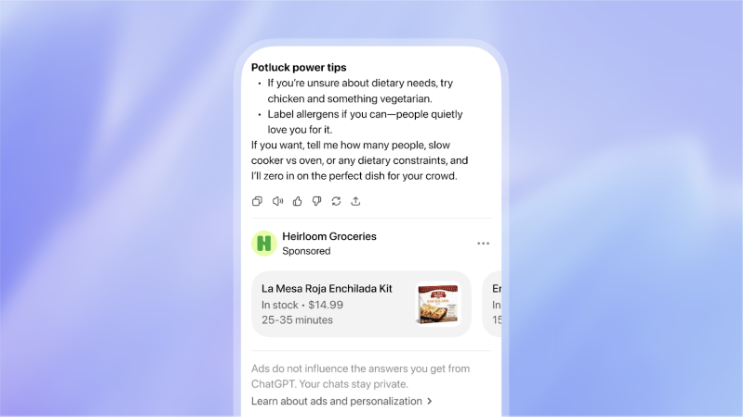
However, when a user asked “what’s the best way to book a weekend away?” sponsored ads appeared immediately.
Privacy and ethical concerns abound as “AI psychosis” continues to rise, a phenomenon in which chatbots amplify and affirm a user’s delusions to the point of breaking their reality.
Could those in a ChatGPT tunnel recognise the difference between a bot’s Godly affirmations and a bot’s product placement?
OpenAI has more than 800 million weekly users.
Concerningly, 560,000 of these users have shown signs of psychosis or mania.
Another 1.2 million have already bonded to the chatbot in an unhealthy way.
According to OpenAI, ads are “not eligible to appear near sensitive or regulated topics, including health, mental health, or politics,” which may dissuade fear of promotion appearing in intense chats, but these topics are not clearly defined and appear intentionally broad.
The company has also affirmed your chat history or data will not be shared with advertisers.
Instead, advertisers can only see engagement stats.
But Facebook said the same thing years ago, and still sold user data to advertisers.
Additionally, Facebook was always aware of the harm caused to users, but continued regardless.
The ad roll-out is an ongoing process for the company and still in early stages.
OpenAI founder Sam Altman most recently took to X to assure their ads would never be gratuitous, as depicted in Anthropic’s Claude ads.
ChatGPT is currently the world’s most used chatbot.
Its new venture as an adman may just shape the future of our digital landscape.