ChatGPT helped disprove a 30-year-old maths conjecture. Here’s the problem in plain English.
Back in 1976, the Four Colour Theorem became famous for being proved with computer help, kicking off an argument over whether machines could really contribute to maths.
Half a century later, they seem to be doing a lot more than checking the work.
ChatGPT has reportedly helped disprove a graph theory idea that survived for almost 30 years. It is called the Dinitz-Garg-Goemans conjecture, but the basic idea is much simpler than the name suggests.
Imagine a warehouse sending deliveries across a city.
Each road has a limit, and some routes cost more than others. In the easy version, you can split a delivery across multiple roads. Half goes one way, half another.
In the harder version, each delivery must stay together and follow one route. You cannot send half a washing machine down the motorway and the rest through the back streets.
Mathematicians call this “unsplittable flow”.
In 1999, researchers showed that a split-up plan could be converted into whole deliveries without causing too much congestion. Michel Goemans then suggested it should also be possible without increasing the cost.
For nearly three decades, nobody could prove that or find an example showing it was false.
Then Dmitry Rybin, co-founder of AI company Autokernel, asked GPT-5.6 Pro to search for a counterexample.
The model failed at first. Rybin pushed it to rethink the problem and, by the fourth prompt, had clearly lost patience.
“Had enough of your failure,” he wrote, before demanding a complete counterexample.
Apparently, tough love works.
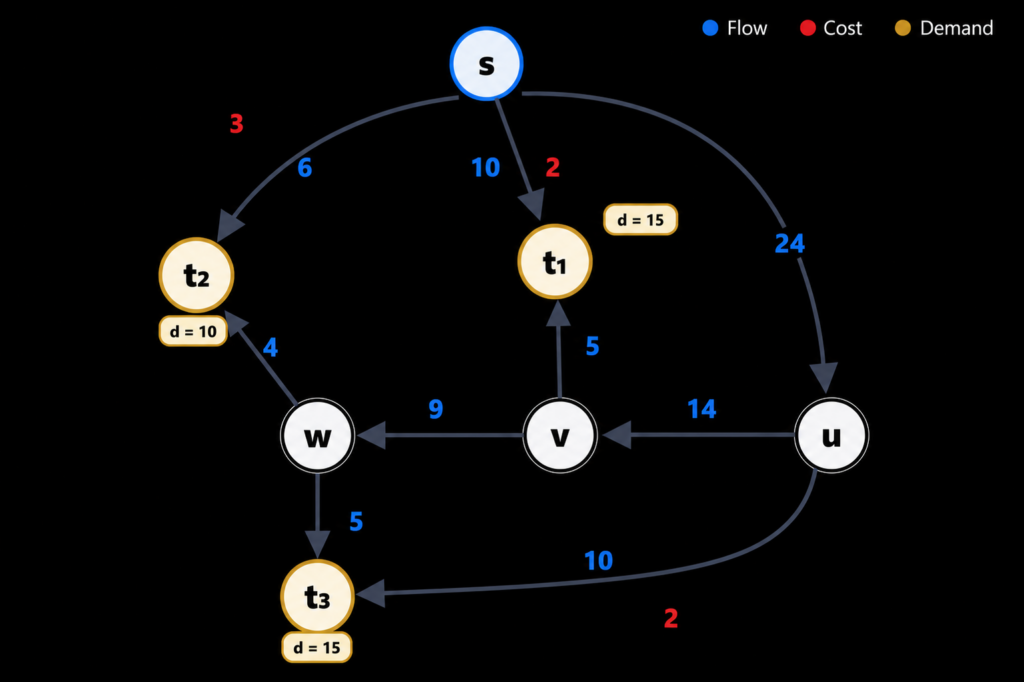
ChatGPT produced a network with seven points, nine connections and three deliveries. When deliveries could be split, the cheapest plan cost 58. When each delivery had to stay together, every acceptable plan cost at least 60.
That tiny difference was enough to break the conjecture.
The network was small enough for humans to check by hand, with only eight possible route combinations.
The AI did not produce an enormous proof or ask everyone to trust a black box. It found one small example showing the rule was not always true.
Rybin still had to know what to ask, recognise the answer and verify it.
But the result shows how useful general-purpose AI can be when the hard part is searching through too many possibilities for one person to test.