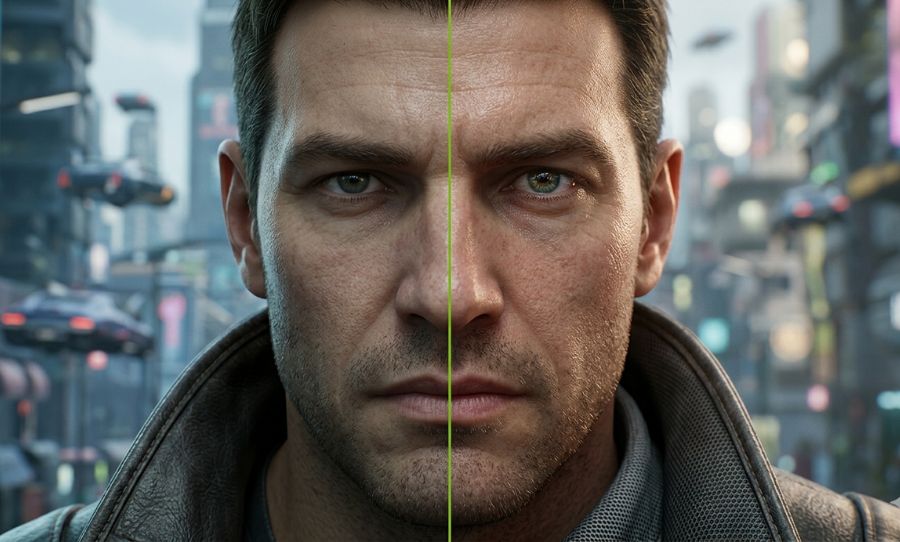
DLSS 5 launches Fall 2026, making games like Resident Evil, Starfield, and Hogwarts Legacy look sharper and more realistic.
NVIDIA’s DLSS 5 is here to shake up gaming graphics again. Unlike earlier versions, which focused on boosting frame rates by letting AI fill in missing pixels, DLSS 5 is all about making games look more realistic.
People are calling it a “GPT moment” for gaming, because the AI doesn’t just sharpen images anymore – it actually understands what it’s looking at.
Here’s the idea: the AI can tell the difference between skin, metal, and wood, and apply textures and lighting more realistically.
Characters’ faces get subtle lighting effects that weren’t possible before, and environments catch shadows and reflections more naturally – all without killing performance by calculating every single ray of light.
The good. in all of this – Older games like Starfield or Hogwarts Legacy can suddenly look sharper and more detailed, with improved lighting and textures that make characters feel more grounded.
The bad – Because AI is effectively “painting over” the original game, sometimes things can look a bit off.
Resident Evil: Requiem’s demo got mixed reactions, with some fans saying the main character looked a little plastic or filtered.
DLSS 5 is set to launch in Fall 2026, and you’ll likely need an RTX 50-series (or newer) GPU to run its full Neural Rendering features.
It won’t be in every game right away, since developers need to integrate it into their engines, but several major titles are already lined up.
Confirmed launch titles
Resident Evil: Requiem (Capcom) – Photorealistic skin and eye reflections.
Starfield (Bethesda) – Improved character lighting.
The Elder Scrolls IV: Oblivion Remastered – Modernized visuals for a classic.
Hogwarts Legacy (Warner Bros.) – Enhanced facial detail on older characters.
Assassin’s Creed Shadows (Ubisoft) – Better fabric and environment lighting.
Phantom Blade Zero
Black State
Delta Force
Studios signed on
Capcom – Future Resident Evil and Monster Hunter games
Bethesda / Xbox – Open-world RPGs
Ubisoft – Environmental realism and lighting
NetEase & Tencent – Competitive and MMO titles
NCSOFT – Next-gen fantasy projects