No old records were harmed in the making of this album, only old ideas.
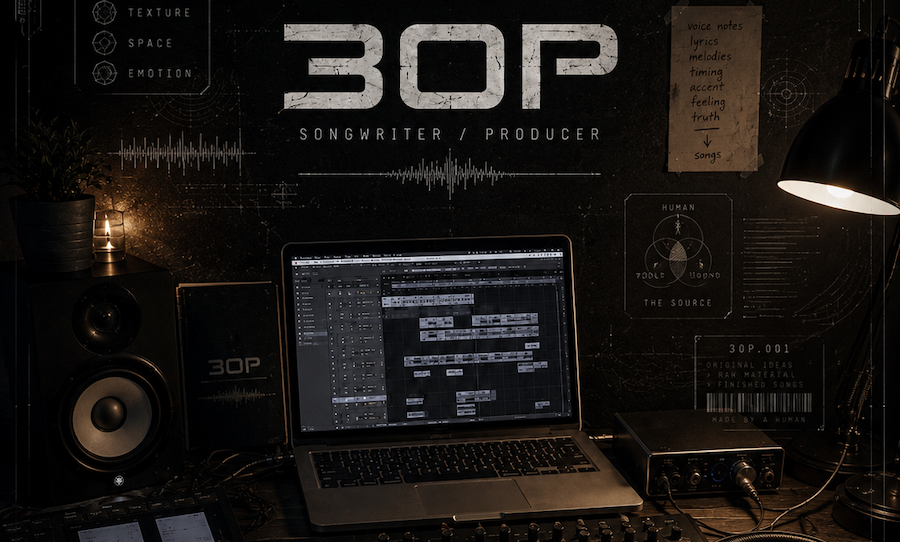
Melbourne-based songwriter and producer Caillan Halliday is turning a lifetime of unfinished ideas into a bold new reality with his project, 30P.
Debut album Sampling In Reverse is the first full statement from this innovative workflow, which he describes as “human-written, AI-assisted.”
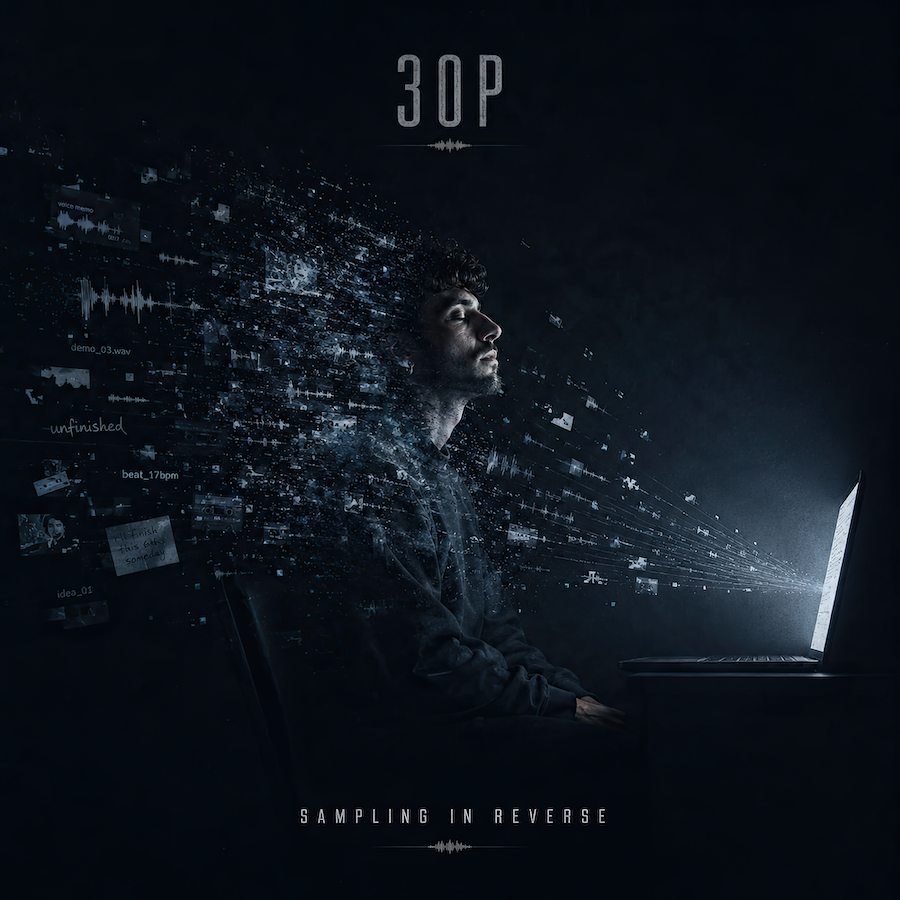
The album is constructed from years of archived demos, lyrics, voice notes, and emotional sketches, using AI not as a magic wand or a thief, but as a “sound variation engine” to unlock material that had been stuck for years.
For Halliday, who is legally blind and a full-time dad, the project is a practical response to the realities of life, building a workflow around home, family, and budget rather than waiting for perfect studio conditions.
The result is a multi-lane catalogue already expanding into electronic, rap, and beat-driven realms.
In this candid interview, Halliday discusses his “source DNA” philosophy, the political edge of tracks like ‘My Prime Minister,’ and why the future of music hinges on honesty, not automation.
HAPPY: What’d you get up to today?
30P: Monday is usually the day I overhaul the house and do a full clean, so today was mostly chores, cleaning, and getting everything back under control.
While I clean, I normally listen to music and brainstorm. When I’m vacuuming, the sound of the vacuum kind of distorts the music, and I start hearing these weird chords and melody ideas through the static. I call them phantom melodies.
That actually happened today. One of those ideas turned into a song while I was cleaning, which is always a good sign.
HAPPY: Tell us a little about where you’re from, and what you love about it!
30P: I’m in Carrum Downs now, near Frankston in Melbourne’s south-east, but I grew up in Bulleen near Doncaster. I also spent a couple of years in London, then moved to Portarlington, and eventually ended up here.
I love Carrum Downs for its community, the farmlands, and being near the beach.
HAPPY: You describe your workflow as starting with “source DNA.” Can you walk us through one song on the album where that original demo, lyric, or phrasing dictated everything that followed?
30P: “Fade Away” is probably the cleanest example. That started from a full song demo, so the structure, phrasing, melody, and emotional direction were already there.
When I say “source DNA,” I mean the original human bit has to stay in control. It might be a voice note, a melody, a lyric, a rhythm, or even just the way a phrase lands.
With “Fade Away,” the production, vocal choices, and atmosphere all followed the original demo. The aim was to take the original seed and, through variations, find the versions and parts that were either inaccessible to me or that I couldn’t perform myself, then use those to complete the song while keeping it emotionally true to where it started.
HAPPY: My Prime Minister has a political edge you’ve mentioned. What reaction are you hoping for when people start engaging with that track?
30P: With “My Prime Minister,” I hope people find a bit of a release point if they’re frustrated with the same things I’m frustrated with.
There’s humour in it as well. It’s tongue-in-cheek, it’s suggestive, and there’s an irony to it being sung in a UK accent. That wasn’t some grand political decision — it just happened to sound really good. I tried Australian versions too, and if I perform it myself it will obviously be in my accent and my voice, but that version just hit. I loved it.
I want people to love it for what it is. It has a hard message, but it isn’t trying to be hurtful for no reason. If you’re the person in that position and the song stings, there’s substance behind that sting. It’s loosely fact-based, wrapped in metaphor, and tied to the frustration of feeling small inside a very large system.
With free speech, government trust, and public frustration being such contentious issues, the song came from that place of feeling like just surviving isn’t enough.
HAPPY: You’re very transparent about using AI as a “sound variation engine.” What’s the biggest misconception people have about AI-assisted music before they hear your project?
30P: I think the biggest misconception is that AI is either magic or theft, when really it depends entirely on how it’s being used.
For me, AI is an assistant, not a replacement. I call it a sound variation engine because that’s what it is in my process. It can absolutely generate parts that end up in the final recording, so I don’t want to pretend it’s not doing anything. The important part is that it’s being directed by the original human idea, not replacing the entire creative process.
The part that matters to me is transparency. You should know what you used AI for. If someone asks, you should be able to explain it clearly: this was my demo, this was my lyric, this was generated, this was chopped, this was resampled, these stems came from a sound variation engine, this was mixed or mastered with an AI-assisted tool, this was replayed, this was kept, and this was thrown out.
That’s where I think the conversation is heading. Not just “is AI good or bad?” but “how much of this did you actually make, how much did you direct, and are you being honest about it?”
HAPPY: How many unfinished songs, voice notes, or demos were sitting in your archive before you started 30P, and what finally unlocked them?
30P: There were a lot. I’ve been making music in different forms for about 20 years, so there were years of unfinished songs, voice notes, demos, beats, lyrics, fragments, and ideas sitting around.
Some of it is rough. Some of it is just me beatboxing into a phone, mumbling melodies, writing raps, or trying to catch an idea before it disappears. I’ve always written, but I didn’t always have the access, confidence, equipment, or collaborators to finish things properly.
What unlocked it was realising I didn’t need to wait for the perfect studio or the perfect team. I could use the tools I had, including AI-assisted tools, to start turning those unfinished ideas into actual songs. 30P came from finally being able to open that archive and finish things instead of just collecting them.
View this post on Instagram
HAPPY: You’re opening up 30P Beats for artist collaborations and beat sales. What are you looking for in an artist who wants to write over your material?
30P: At the moment I’m mostly looking for singers, instrumentalists, DJs, producers, and artists who connect with the material in a way that feels real.
There’ll be some beats and instrumentals available to lease, but purchasing or exclusive use would be more selective. That would either be through a proper collaboration, or me being brought in more directly as a service.
What I’m really looking for is people who want music that feels a bit different from what you hear every day. I try to make music that has familiar characteristics, but gives people another river to outlet through. Something they can hear themselves inside, but not something that feels copied from whatever is currently working.
The hope is to inspire people to be creative regardless of their background, and to build genuine connections with different types of artists at different levels.
HAPPY: What’s a boundary-pushing collaboration you’d say yes to immediately, no questions asked?
30P: There are too many, honestly. Aphex Twin, The Avalanches, Ben Kenney, Boards of Canada, Bob Vylan, Burial, Clark, Fontaines D.C., Fred again, Ghetts, Hiatus Kaiyote / Nai Palm, Lapalux, The Mouse Outfit, Radiohead / Thom Yorke, Skrillex, The Streets.
But really, anyone who could pull 30P somewhere I couldn’t take it by myself — that’s the collaboration I’d say yes to immediately.
HAPPY: Five years from now, if 30P is exactly where you hope it’ll be, what does that look like? More albums, more lanes, or something else entirely?
30P: Five years from now, I’d like 30P to be a globally established identity and musical personality, working with top-tier artists and continuing to push sound exploration.
Right now I’ve already got multiple lanes moving — an indie album, a rap album, an electronic album, Sampling In Reverse 2, plus beats and instrumentals. Sample packs are probably the most likely thing to come out next, because I love the idea of giving other people sounds they can pull apart, flip, and build with.
So yes, definitely more albums, but also 30P Beats, collaborations, remix projects, instrumentals, sample packs, and different releases that let the project keep mutating without losing its centre.
The main thing is that it stays honest: human-written, AI-assisted where it makes sense, transparent about the process, and built from real ideas rather than just chasing output.
If it works the way I hope, 30P becomes more than just my music. It becomes a community of empowered individuals who can access free tools, build with them, and be part of it — not necessarily as paying customers, just good people making things.
HAPPY: Lastly, what makes you happy?
30P: My family, first. My partner, my kids, and those small moments where the house feels calm for five seconds.
Creatively, finishing things makes me happy. Hearing an idea turn into something real after it’s been sitting in my head or buried in a voice note for years. That feeling is hard to beat.
I also get a lot of happiness from seeing other people realise they can make things. That’s probably the deeper part of 30P for me. Music has given me a way to keep going, process things, and build something out of the mess, so if any of this helps someone else feel like they can create too, that’s a great outcome.