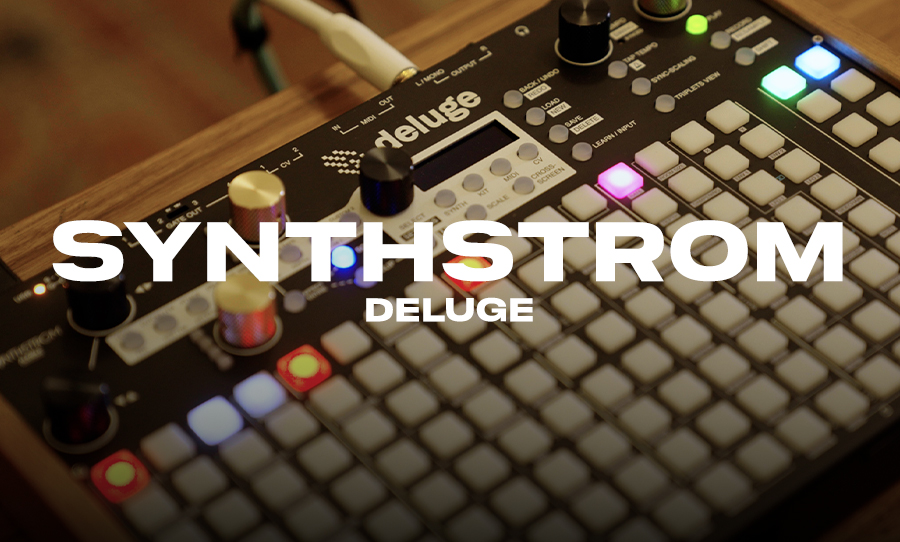
The Synthstrom Deluge is a standalone synth, sampler, sequencer and looper that can genuinely replace your DAW for writing and performing.
With deep polyphonic synthesis, SD streaming sampling, massive sequencing power, MPE support, CV and MIDI connectivity, battery operation and ongoing firmware development, it works as both the brain of a hardware studio and a portable idea machine.
View this post on Instagram
Made by boutique manufacturer Synthstrom Audible out of Wellington, New Zealand, the Deluge has always felt like an instrument designed by someone who actually performs and actually finishes music. It’s a standalone synthesiser, sampler, sequencer, and looper that lives in a single, battery powered box, with a workflow that rewards momentum more than perfection.
Deluge first started shipping to customers in March 2017, and the story since then has been one of ongoing development rather than a product that froze in time after launch. It has grown into a far deeper platform through firmware, while keeping the same core idea intact: your hands on pads, your ears in charge, and your track taking shape in real time.
The heart of the Deluge experience is its pad grid. One hundred and twenty eight full RGB pads give you a piano roll style view for sequencing, with scrolling and zooming that feels closer to a DAW than a traditional hardware step sequencer. That matters because Deluge is not just about making eight bar loops. It includes an arranger view for building longer compositions, plus clip style interaction for launching, muting, and performing your parts live. Sequencing depth is huge, with resolution that can go extremely fine, and project scale limited more by available memory and processing than by artificial pattern limits.
Then there is the engine room. Deluge includes a full internal synthesiser architecture covering subtractive, wavetable, and FM, with polyphony effectively limited by CPU and up to sixty four synth voices possible depending on what you are asking it to do. It supports MPE, meaning expressive controllers can push pressure, pitch, and gesture into most parameters, and you can record that expression into sequences rather than treating it as a live only trick.
The synth side is not a token add on either. You have filters in multiple slopes, drive options, oscillator sync, ring modulation, unison detune, portamento, and a modulation system that invites movement. LFOs and envelopes live on each synth or sample, and the modulation matrix is built for performance as much as programming. Two endless encoders with LED metering encourage live adjustment, and parameter automation recording means you can capture those moves as part of the composition rather than trying to recreate them later.
Sampling is equally serious. Deluge streams samples directly from the SD card rather than limiting you to whatever fits in RAM, which changes how you build sets and projects. Time stretching, pitch shifting, multisampling, slicing, waveform editing on the pad grid, and resampling all feed into a workflow where you can treat audio as playable material rather than fixed loops. Add the built in effects suite, including delay, reverb, chorus, flanger, phaser, bitcrusher, sidechain style effects, and live stutter tools, and it becomes a complete sound shaping environment rather than just a sequencer with sounds attached.
Connectivity is another reason Deluge has become a centrepiece in so many setups. Alongside MIDI over USB and hardware connectors, it offers CV and gate outputs for modular and semi modular rigs, configurable clocking, and the ability to run as master or follower. It can sequence external gear across all 16 MIDI channels while simultaneously driving internal synths and samples, effectively acting as the brain of a hardware studio.
A key turning point for many users was the screen update in 2022, when Synthstrom began shipping units with an OLED display. The improved screen made navigation, naming, and deep editing significantly more intuitive, especially for larger projects. Crucially, it did not change the core philosophy. Deluge remains an ears first instrument, just with less friction when you are deep in a session.
What makes Deluge special is not any single feature. It’s the way it supports a complete creative loop. Generate a pattern, shape a synth, record automation, resample, slice, arrange, and perform, all without the device pushing you back to a computer. Equally comfortable being a live performance tool, a songwriting scratchpad, or a full production environment, well worth a visit to see how it play a role in our workflow.