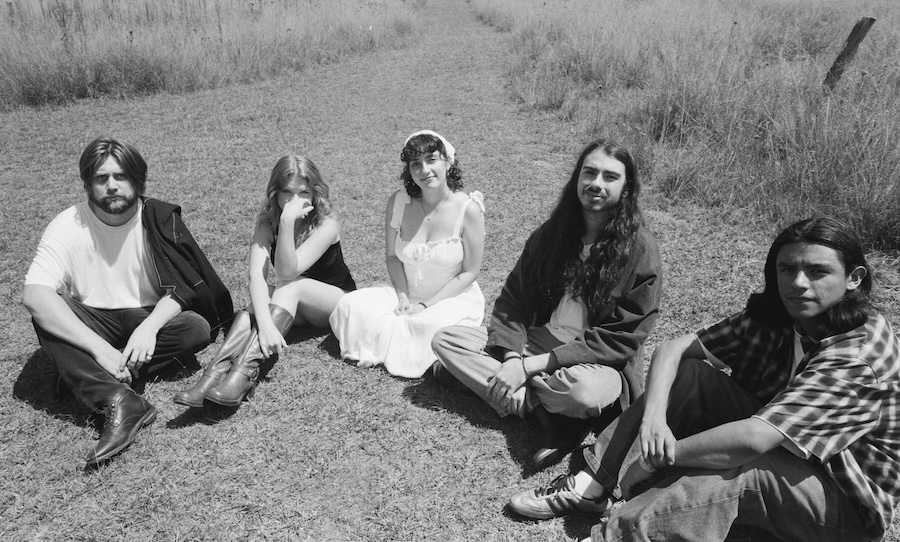
The Hawkesbury artist and director Nirash Perera discuss revenge, romance and the making of a gothic masterpiece.
Jean Elliot has never been one for half-measures.
The Hawkesbury artist crafts music steeped in the raw, lawless spirit of rural Australia, where tin roofs rust, barbed wire fences divide, and the bush holds secrets too dark for the city.
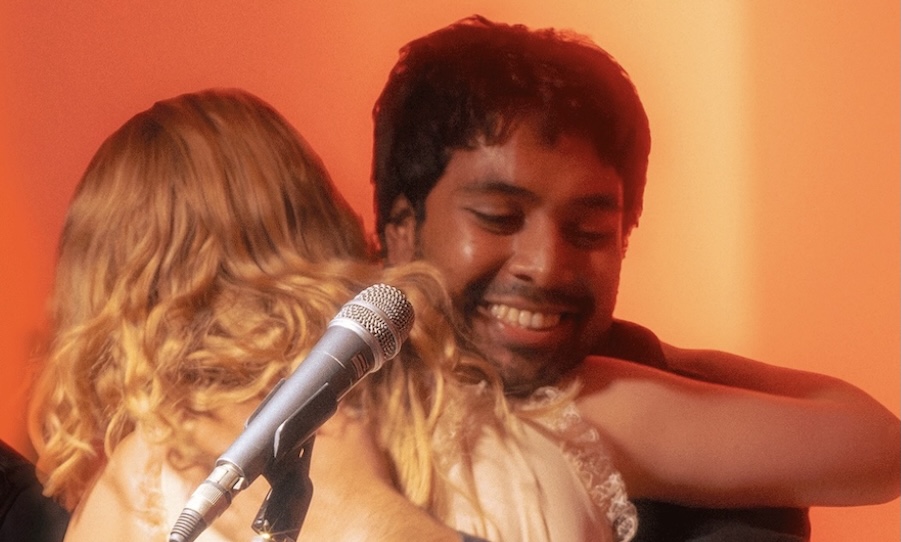
Following the success of her debut EP Butcher, Lover, Runner, Elliot returns with a cinematic music video for fan-favourite track ‘Beneath Your Sun.’
Directed by rising talent Nirash Perera, the visual drags viewers into a world of revenge and romance, where scorned lovers build scarecrows only to tear them down.
Shot amidst dense wily bushland, the clip balances quirky Australian gothic charm with the band’s electrifying live presence.
To mark the release, we sat down with Elliot and Perera as they turned the tables on each other, discussing unrequited love, roadkill imagery, and the suffocating beauty of the Hawkesbury.
What emerged was a candid conversation about storytelling, collaboration, and the creative process behind one of the year’s most distinctive music videos.
Jean Elliot asks Nirash Perera
JEAN ELLIOT: What was the first image that came to mind when you heard ‘Beneath Your Sun’?
NIRASH PERERA: I remember listening to the song for the first time and seeing roadkill rotting and bubbling underneath the sun. I mean, not only is that an incredibly literal way to interpret the song but it was my first impulse.
So a pretty damn weak interpretation for sure aha.
ELLIOT: When did you realise the scarecrow should become the ex-lover?
PERERA: I realised the second Layla and I were talking about some ideas for the video. She had mentioned that she wanted to “smash a pumpkin” and in that moment the entire music video struck me.
I knew I could take something as pure as a little pumpkin friend and Frankenstein him into a representation of someone’s unrequited love… it just made sense to me.
ELLIOT: What part of the song did you find hardest to translate visually?
PERERA: I’d say the stark transition from Caroline and The Butcher basking in the radiance of their love to utter heartbreak and anger. In the original cut of the video there wasn’t a sequence of Caroline searching for The Butcher in the woods, and it was really frustrating in the edit without that insert, as it read quite confusing at first. Luckily we had time for some re-shoots.
Also her and Mr. Pumpkin’s (I like to call him that) friendship.
ELLIOT: How did you approach the Australian gothic side without making it feel too polished or theatrical?
PERERA: That’s an awesome question. Mahdi and I (my cinematographer and dear friend) drove around Cattai listening to Butcher, Lover, Runner videoing random things that we felt reflected the music.
We both looked at the footage later and followed our instincts on the day of the shoot for what felt like it captured the song and the “Australian Gothic”.
I remember I specifically said that we should aim to shoot on a day where it was overcast so any colour would contrast the scenery rather than having a beautiful blue sky to complement the colours.
That really helped with the vibe. I think Layla’s presence as an actor also helped with that, she fits “Australian Gothic” well.
ELLIOT: Was there anything about the location that changed your original plan?
PERERA: Not really actually. We originally intended to shoot at a national park, but after realising the ridiculous amount of money we had to fork out to make that happen, we quickly realised that the blocking could remain the same in any open field.
I remember an absolute non-negotiable for me was to have tall, tall trees surrounding the final few scenes to really mirror the stature of Mr. Pumpkin as a scarecrow in order to accentuate how alone he himself felt.
Luckily for us, we scored someone’s amazing backyard to shoot the scenes and it fit the brief incredibly well.
ELLIOT: What did you see in my performance that I might not have noticed myself?
PERERA: I think Layla’s pretty self-aware. If anything I think there’s so much joy in watching not just Layla but the entire band perform, but I think they know that already. It was important for the music video to be fun to reflect this.
ELLIOT: Which shot are you most proud of?
PERERA: Oh man, that’s tough… I’d say the scene where Layla is absolutely destroying Mr. Pumpkin.
We went into that scene with zero planning and I was winging it. I was super nervous as I’d never choreographed an action scene before and that fucking axe was so heavy I was worried someone was gonna get hurt.
On top of that we only had one shot to shoot the scene as I had only built one scarecrow.
So I’m proud of how that specific scene came out! Not only that, Layla absolutely crushed the acting on that scene and really translated how cathartic I wanted that scene to feel.
ELLIOT: What tiny detail in the video do you hope people pick up on?
PERERA: There’s a scene of Mr. Pumpkin and Layla through the years growing up together shot on polaroid.
I love that scene and I think it adds a lot to their history. It’s so simple but I think it’s effective.
ELLIOT: Did directing the clip change the way you heard the song?
PERERA: Most definitely. It’s a beautiful song about unrequited love and it’s so clear but complex, not complicated! I think that’s ridiculously hard to achieve…
ELLIOT: What would you want to push further if we made another video together?
PERERA: I think scale for sure. I know we can go bigger and far more intimate. I personally think Layla is a fantastic actor and I’d wanna push her a bit more too.
ELLIOT: What makes you happy?
PERERA: Oh man, learning new things, watching awesome movies, spending time with my family, writing for sure, and my girlfriend. Chess too, I’ve picked up a habit to play that. I will say, being on set with my crew is just so fun.
I’m pretty lucky to have a great set of friends who share the same excitement I have.
I can’t forget my dog Benji – he’s pretty charming too. Oh, and Bob Marley. Fuck, I forgot The Beatles too, specifically Abbey Road.
Nirash Perera asks Jean Elliot
PERERA: Where did the roadkill image in ‘Beneath Your Sun’ come from?
ELLIOT: Describing a relationship as a hit and run left me with this image of an animal being left on the roadside to rot in the sun. Everybody passes, letting it happen, watching the animal decompose more and more every day.
It’s a natural process, much like grieving somebody, but it’s gruesome and lonely.
If the subject of the song was the sun, it was for both good and bad reasons. Bright and beautiful, but also the reason why I deteriorated on the side of the road so quickly.
PERERA: Did the song begin with the almost-lover, the lyrics or the guitar sound?
ELLIOT: Almost-lover, lyrics, then guitar. Lyrics always come first for me, inspired by something or in this case someone.
This song was written years ago, and I still remember sitting on my bed in lamp light on a rainy day writing the lyrics out.
A lot of the original production from that first recording was kept, including guitar parts and all of the backing vocals that are so pivotal to the song.
The band added so much to the song, which gave the final recording a new life that moved beyond just the lament of an almost-lover.
PERERA: How much of it belongs to real life, and how much belongs to the Devil’s Wilderness?
ELLIOT: This song was not initially meant to be part of Butcher, Lover, Runner. In my head, it didn’t fit the lore of the universe I was laying the foundations of with the release of this EP.
But I came to realise that “Beneath Your Sun” was inspired by the same events that kickstarted my urge to write about witch hunters and cheating butchers.
I decided to change some lyrics to situate the track deeper in The Devil’s Wilderness and abstract it further from my personal life.
For example, “as the bugs eat up my lungs, the taste of you will salt their tongues” replaced a more pointed personal lyric and pushed the story further away from real life events. In the world of Butcher, Lover, Runner, “Beneath Your Sun” serves as a scolding recollection of the protagonist’s relationship with the Butcher, but I suppose that’s always what it was for me, too.
PERERA: When did Butcher, Lover, Runner become a full story rather than just a group of songs?
ELLIOT: This EP was a full story way before it became a group of songs.
I don’t think I can simply collect songs together for a longform release without there being a throughline, and I prefer to write to already established stories anyway. I was initially planning on working towards telling the full story in an album titled Preycatcher.
But I thought it would be better to present listeners with the prequel in Butcher, Lover, Runner before I get too crazy with the storytelling aspect of my music.
All of the tracks were written for the story and were selected for this EP from the wider collection of Preycatcher songs because they made the best introduction to the core three characters: the Butcher (the subject of the first three tracks), the protagonist on the run and her lover Lennon (who are the subject of the final three tracks).
PERERA: Your vocals move between restraint and something much more forceful. How conscious was that when recording?
ELLIOT: ‘Beneath Your Sun’ was already fully recorded years ago. We re-approached it in the studio with our amazing engineer Indigo Parker with reinvigorating the track with the band in mind.
When re-recording the vocals, I really wanted to channel the same performance I gave when I initially recorded the track, as I was in the throes of what the song was about. In the verses when I’m baring my bones, I think the restraint came naturally.
When it comes to those choruses, and especially the bridge where I accuse the subject of guilt, the dramatic delivery comes naturally. No matter how long ago things were, songs can immortalise certain feelings.
I feel it the most when I perform it live and suddenly my voice is whispering and wailing again with the same intensity as that first recording.
PERERA: What has growing up in the Hawkesbury given your music?
ELLIOT: Sometimes it feels like people are born, live and die in the Hawkesbury. It’s a beautiful place to live but it has that suffocation of being too small and insular that gives the storylines and personal details in my music a bitter edge.
Part of why I chose a stage name was to avoid derision for as long as I could. A lot of the imagery of Butcher, Lover, Runner, in its oscillation between blokes at the pub and scrubby bushland, reflects home.
I also think that from a ‘business’ point of view, growing up and operating from so far beyond the Sydney city scene allows me to engage more critically with it and bring something different to the noise.
PERERA: Has running Doghouse changed the way you think about your own role in the local scene?
ELLIOT: It has certainly made me see the discrepancies between urban and regional scenes a lot clearer.
What goes on in the inner west is so vibrant and full of momentum, and it always makes me think of ways to bring the kinds of opportunities the city scene creates back to the creatives at home.
I have never fully felt ‘part’ of the scene, and I think that’s where Doghouse came from: trying to bring the momentum home.
It’s certainly not as easy as the inner west makes it seem (even only an hour or two away) but there’s a lot to learn from being a musician out there.
I want to keep learning and doing what I can for the Hawkesbury, and keep inviting people who I meet in the city to look a little further west and see how much we have to offer, and how much we deserve.
PERERA: Which character from the EP do you feel closest to?
ELLIOT: This is a hard question to answer, considering that I put a piece of myself into all three titular characters across the EP. In the Butcher I put my obsessive side and my inability to let go of my longing for revenge.
In Lennon, my knack for self-preservation and romance. The ‘runner,’ or Caroline, as you would know her in the novel I’m writing, I put my desire for escape, bitterness and sentimentality.
I feel like it’s necessary to writing dimensional characters that you don’t shun them from you, but shape them with different aspects of yourself and the world around you.
PERERA: Did seeing the scarecrow version of the story change how you viewed the song?
ELLIOT: It was interesting to see somebody else’s interpretation of my own bitterness and feelings I’d put into the lyrics of the song.
I was happy that Nirash gave the story a much needed catharsis that isn’t reached in the song through the scarecrow.
The song only really goes through these neurotic motions of anger and blame without a wilder release.
PERERA: Where do you want to take this world next?
ELLIOT: There’s a novel being written that covers all of Butcher, Lover, Runner’s lore, and the continued story.
The album companion is also coming. And I can safely say Nirash and I will collaborate again before the story is done.
PERERA: What makes you happy?
ELLIOT: Watching horror game lets-plays with my best friend Maeve, dogs and hillbilly pizza in Bilpin.
Driving through the bush, Ethel Cain SoundCloud demos and writing songs.
It makes me happy when I have really vivid dreams that I can remember in the morning. My boyfriend and I’s garden.