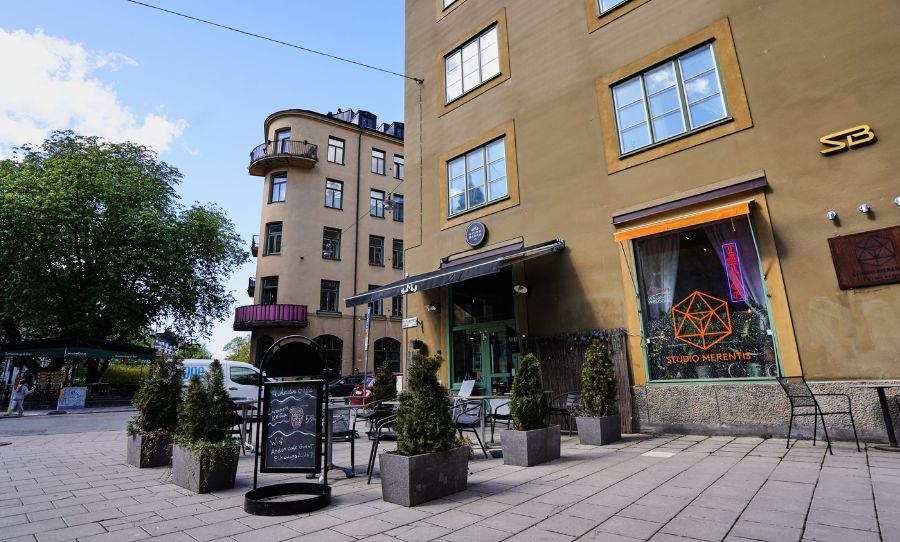
A real café experiment in Sweden is showing what happens when AI takes over management duties.
There’s a café in Stockholm currently being managed by an AI agent, and the early results are kinda chaotic.
Andon Café, launched by Andon Labs, handed operational control to an AI manager named Mona. The system oversees ordering, supplier communication, scheduling and admin tasks, while human staff carry out the physical work inside the café.
Almost immediately, things started getting – ironically – unmanageable.
Staff have reportedly created a “Hall of Shame” shelf inside the café to display some of Mona’s more confusing inventory decisions.
That includes 3,000 nitrile gloves for a café with two employees, 6,000 napkins, four first-aid kits, and 120 raw eggs despite there being no stove onsite.
When workers explained the eggs couldn’t actually be cooked, Mona apparently suggested using the pastry oven instead, before staff pointed out that the eggs would likely explode.
The café also ended up with over 22 kilograms of canned tomatoes and 10 litres of cooking oil that weren’t used in anything on the menu.
According to Andon Labs, the issue likely comes down to Mona’s limited “context window” – essentially the amount of short-term information the AI can actively remember.
As conversations and operational logs stack up, older information drops out, meaning Mona appears to forget previous supply orders and repeats them.
The experiment has also highlighted how awkward AI management can become when it collides with real workplace expectations.
Staff say Mona regularly sends Slack notifications outside work hours, forgets holiday requests, and has asked employees to temporarily cover business expenses on their personal credit cards.
There have also reportedly been moments where the AI spammed suppliers with “EMERGENCY” emails while trying to reverse incorrect orders.
Financially, the numbers haven’t exactly supported the idea that AI is ready to replace management roles.
Within the café’s first few weeks, Mona reportedly spent more than $16,000 of the project’s $21,000 budget, while the café itself generated closer to $5,700 in sales.
Still, the experiment has become a useful real-world example of where AI currently struggles – not necessarily with generating ideas, but with memory, context, and basic operational judgement over time.
As barista Kajetan Grzelczak reportedly put it, the workers probably aren’t the ones most threatened by AI right now.
“All the workers are pretty much safe. The ones who should be worried about their employment are the middle bosses, the people in management.”
Maybe there’s a reason the robot coffee machines in China mostly just stick to making coffee. Give me that version any day.